Wednesday, June 13, 2007


Tuesday, May 15, 2007
And don't forget JFK assassins!

The fact of the matter is, this cartoon applies not only to conspiratorialists, but also to anyone who selectively applies data to suport a pet theory, not just young earth creationists, but atheist secularists, anthropogenic global warming-ists, etc.
We all have pet theories or mental models about the world in which causation is often ambiguous. I wonder, though -- is the goal for a good thinker to be right as much as being open to understanding why one might be wrong? I don't think the two have to be mutually exclusive, but an attitude of humility would seem to dictate that the latter rather than the former takes a higher precedence. It would seem, at least, that the two should exist in some tension.
Saturday, March 31, 2007
Rodan the Destroyer and Getting Things Right
“Do you remember when you got that B in your aerospace design class for turning in a paper airplane? That took Big Kahunas!”
George just had to bring this up. I turned away, crestfallen, to the setting sun. Nineteen years later, I am still mad about the B.
I began my enginerding career as an Aerospace major (I transferred to Mechanical in my junior year). In the spring quarter or 1987, I took “Introduction to Aerospace” from Rodan the Destroyer.

He was known to fly at supersonic speeds, even at low altitudes.
For the final class project, Prof. Rodan assigned a design project in which we were to use the principles we had learned in his class to develop an airplane that could perform three flight functions:
- fly “straight” across the length of the classroom
- turn a vertical loop in flight
- turn a horizontal loop in flight
The only restriction placed on the design parameters was that to perform the maneuvers, we could only add/remove mass or change the control surfaces of the plane. Those were the only instructions he gave us.
Since this was an introductory class, I didn't know much yet about airplane design. I thought the best way to proceed was to copy the designs of aerobatic planes and scale them to a hand-held size. I used balsa wood and card board. Nothing worked. I considered stealing the Tech Tower “T” just to vent my frustration.

Then I remembered a delta wing paper airplane I was fond of making as a kid. It would do all kinds of aerobatics just by modifying the wing surface with flaps cut into the trailing edge of the wings. If the flaps were both turned up, the plane would do a vertical loop. If the flaps were turned in opposite directions, it would turn in a horizontal loop when thrust with a quick flick to the left. I was just about there. All I needed was to get the plane to fly straight for about 50 feet. But the plane was too unstable. It seemed unwilling to respond to any control surface modifications I made to achieve the final requirement.
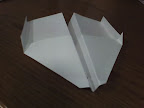
George P. Burdell, a man known for his flights of fancy, offered brilliant advice. “Why don't you add mass to it. Maybe the added momentum will overcome the slight pressure changes that force the light plane to turn.” By taping a penny in the forward section of the airplane, the plane flew with stability in a straight path of just about the length I needed. A little practice got this right. Now all design criteria were met. The plane that did exactly what Prof. Rodan had ordered.

The due date of the project finally arrived. Everyone else showed up in class with the kind of things you would expect NASA engineers to design. Balsa wood monstrosities. Gleaming shellac. Rubber band powered motors. I swear, one student's plane had jet engines made from small aerosol cans. I felt like the one Cub Scout at the Pinewood Derby whose dad didn't make his car. Did these kids' parents work for JPL?
But then the test came. No one's plane could perform according to the design criteria. They were just too big and too bulky to fly within the confines of the Guggenheim classroom on Cherry Street. No one's plane, except mine, that is, would perform as specified. I felt victorious. My little paper airplane ruled the roost.
But then a cry went up from the masses. “We have to fly our planes outside!” The class teetered on the verge of mutiny. Rodan gave in. We went outside. Paper airplanes don't fly well in the brisk spring winds of Georgia.
When I received my grade for the project, Prof. Rodan had assigned me a D.
A D! I went to argue my case. “You said our airplanes had to perform the three flight function in the classroom. My airplane was the only one that would do that.”
“Yes, but I wanted something more substantial than a paper airplane.” Prof. Rodan expelled his uranium ignited nuclear breath.
“But you didn't say that. Your only criteria was that the plane fly the three functions in the classroom. My airplane alone did that. Everyone else deserves a D.”
My atomic shield had worked. Rodan again gave in and moved my grade to a B. I was nonplussed, though, because I believed then, as I do now, that I deserved an A.
Now, I don't usually assume to know people's motivations, but the cynical side of me suggests that Prof. Rodan wanted his students to reflect his brilliance as a teacher. When I'm less cynical, I think he just wanted to see something snazzy. But he certainly couldn't state either preference, likely for several reasons.
“It sounds like you learned a valuable lesson about design, especially design for clients,” quipped George.
By now you have probably guessed the problem: Prof. Rodan had a hidden, unstated preference. Simple requirements analysis won't uncover those. Often times, clients haven't even considered what is motivating them to seek a solution or satisfy a desire in the first place. They are simply responding to a burr in their saddle or a bee in their bonnet with a limited set of easily accessible alternatives. Such ambiguity is the bugaboo of planning, design, or problem solving opportunities. Even if one satisfies every client-specified design criteria, the client may still express disappointment and frustration that the real problem hasn't been addressed according to the underlying preferences. And if you have ever been the consultant or engineer trying to help in such a situation, you were likely completely caught off guard. After all, you did exactly what the client asked. The problem is, you brilliantly solved precisely the wrong problem. [Editor's note: In a recent client engagement, I was told that another consultant was released, in part, because he provided what the client asked for, just not what the client wanted. I felt very bad for this fellow.]
And things were likely worse if you went beyond the client's expectations by providing more bells and whistles. Design scope creep simply solves the wrong problem with greater flourish.
What do you do? Shouldn't you solve the problem as the client asks? Shouldn't you always do more than the client expects?
The answer requires two things from you. First, you have to give up any notion that you are the expert. You may be the expert in your design field, but you are not the expert in your clients' preferences. Only the client has such expertise, but it may take some clever facilitation to draw it out. Second, you must help transform your client into a values-based decision making organization. What this entails is digging and prodding to find out what really matters most, to uncover the primary objective and all its supporting means objectives. Once this hierarchy of values has been resolved, you can work with your client to be much more creative about the alternatives that can be exercised to achieve the real goal.
A few other benefits arise as well from this process. Once the primary objective has been clarified, you can know exactly how to measure success with little or no ambiguity. Also, once you understand how the means objectives relate to support the primary objective, you can begin to gain insights into how trade-offs may have to be managed. But most importantly, your client will begin to see you as a trusted advisor who does much more than simply react to requests for proposals. You will be seen as a person who has a vested interest in the client's success. And that makes everyone happy in the end.
I eventually left aerospace engineering for the highly lucrative career of secondary education (which I eventually left for med school, then engineering again, and finally the exciting field of hot dog sales). But Prof. Rodan taught me a valuable lesson about serving my clients even if I learned nothing about airplane design. Today, my clients are happier for it, especially when they fly.
Editor's Note: to learn more about values-focused thinking, read Ralph Keeney's book,
Value-Focused Thinking: A Path to Creative Decisionmaking.
I highly recommend it.
Monday, March 19, 2007
Why we home-school FAQ
When we considered the nation-wide failure to deliver quality education represented by the massive social works programs of government school systems in our country, and that government-hampered competition has not yet produced many private systems that are both affordable and provide remarkable quality (although this is now rapidly changing with the emergence of University Model Schools), home-schooling became the apparent practical and economic solution to our desires and needs for our children.
Essentially, we home-school our children because we believe that no one else other than the parents of our children (that's us) comprehensively know what our children need and respond to best.
The following represent a few questions we have received over the years and how we respond to them.
How will your children learn socialization if they aren't around other children?
First of all, you are assuming that we have isolated our children from other children. That is not the case. Our children participate in church activities, local sports, and scouts. In addition, we have next-door neighbors who have children, and they play with them regularly. Childhood is a beautiful time of life, and we believe that children should play often with other children.
However, we do not believe that children should learn their life skills nearly exclusively and largely from other children. Traditionally educated children do learn their life skills by being associated with other children for the largest part of their waking day. Rather we believe that the purpose of childhood is to learn to be a successful and contributing adult. The best place to learn the skills required to be such an adult is in the presence of successful and contributing adults. In other words, we believe that children should learn their socialization skills from adults first and from children second. The best way for them to do this is to spend the largest part of their time with the adults who have a vested interest in their personal well-being and development. Children are not concerned about the development of other children nor do they have the life skills to know what are ultimately in the long term interests of other children. Only adults have such experience and skill.
Why don't you trust the public school system?
If I sent my children to a parochial or other religiously affiliated school, I would expect that the world-view of the body that organized the school to inculcate their values in their students. Education naturally entails a transmission of values. It is not value neutral. We personally do not agree with the values (or lack of them) being transmitted in the schools organized by the government. We simply do not trust that people who do not have a personal, vested interest in our children, and yet would have the largest daily influence on their lives, will attempt to inculcate the values we believe are important for our children to understand.
Secondly, most government bureaucracies do not exhibit a high degree of efficiency or accomplishment in achieving the goals that our Constitution established as the appropriate purposes of government. When you consider the overall state of decay in the current government school systems, the question really is: "Why do YOU TRUST the public schools systems?"
Won't your children feel left out if they don't get to participate in a school setting like their friends?
Actually, our children feel a high degree of pride that their parents have made many sacrifices to home-school them and that they are getting probably the best form of education available from the people that love them most. More often than not, they feel sorry for children that go to traditional schools.
Secondly, as a parent, we have to discern what is best for our children regardless of our children's feelings about our decisions. There are many things we withhold from our children that they often want that we believe are not good for them.
I know a family who home-schools, and their children are behind academically. Aren't you afraid that your children will be behind as well?
Currently, our children are performing at or beyond grade levels beyond their peers, depending on the subject. Unless we quit what we're doing or decline in our commitment, it's not likely that they will slow down or get behind.
Also, it is not rational to extrapolate a singular experience to an entire population. This type of thinking is the basis for prejudice and bigotry. Most measurable outcomes, such as academic achievement, generate a distribution of possible outcomes. The family you know may for many reasons simply be falling out on the lower tail of the distribution. There are many reasons that the family you know may not be excelling, and not all families are characterized by such reasons.
Statistically, home-school children outperform their peers in private and public school, in that order. They score higher on standardized tests, perform at higher grade levels for their age, and excel in national contests such as the National Spelling Bee and National Geography Bee. Statistically speaking, then, the desired outcome is on our side.
How long will you home-school?
As long as we feel it is appropriate.
It is important to understand that home-schooling does not necessarily imply sitting around the kitchen table for all learning. Home-schooling simply means that the family is the controlling moral, legal, and economic authority with the responsibility for educating our children. As such, we may opt for tutors and other collaborative educational groups as the need arises.
In October 2007, I took my son, Forrest, on a sailiing trip with a friend down the Atlantic coast. While on our trip, Forrest learned to navigate, take soundings, establish his bearings, and learn to tie knots from Pop. We saw numerous examples of wildlife rarely seen in the north Georgia mountains such as dolphins, sharks, bald eagles, osprey, and alligators. We had some great meals and some that were quite Spartan. We learned to cope, adapt, and make rapid decisions in a quickly changing enviroment. We learned how to suppress the inclination to complain in the face of sea sickness, cold wind, and peanuts for dinner. We realized just how insignificant we were in the grand scale of the sea and sky, and that regardless of how resourceful we were, we were still at the mercy of forces beyond our control. We relied on God to protect us and secure our faith in His grace. Like Odysseus, we recalled how much we love home and looked forward to getting there, enjoyed the friendship of great comrades (Jeff, the captain, and Pop, the first mate), and learned to embrace adventure. This was not schooling in the home, but a life-time enduring education on the high seas. If my son had been in government school, I could have been fined for what would have been an unexcused absence.
Aren't home-schooling families right wing religious nuts?
Many home-schooling families are probably rightly characterized as being religiously and socially conservative. However, many families are socially liberal, atheist, "left wing religious nuts", etc. In short, there are many reasons parents choose to home-school, and the diversity of the social/political/religious make-up of these families is reflected in the diversity of the reasons they choose to home-school. Many of the early families in the home-schooling movement were probably best described as hippies - hardly right wing religious nuts!
How do home-schooled children compare academically to children who go to private school or public schools?
Statistically, they exceed the performance of private and government schooled children.
Can your children get into college? Will they be able to compete once they get there?
Recognizing the superior character and educational accomplishments of many home-school children, many colleges and universities are now actively recruiting home-schooled children to attend their schools. These include Ivy League schools as well. Also, as the prevalence of home-schooling is increasing, many colleges are being established now that recruit only home-schooled children.
All the evidence indicates that home-schooled children continue to excel both in and beyond their college experience.
You were educated in public school. It didn't seem to hurt you.
While I agree that the government schools I attended were not devastating, I do not agree that the experience did not harm me. In government schools, I was under the tutelage of many lackadaisical teachers and administrators, constantly exposed to the disruptive behavior of children who did not receive appropriate guidance from home, and drilled in an academic environment that is considered by most of the industrialized world standards as substandard. In the government schools I was exposed to drugs, violence and sex at age-inappropriate times. The level of involvement and discipline I received from teachers and administrators was minimal and commensurate not so much with people who don't care as much as people who are overwhelmed with an impossible task and did not have a parental level of vested interest in my development and growth.
Would you please buy wrapping paper, candy, etc. to supplement our child’s school’s educational budget?
In addition to the financial burden we have undertaken to personally educate our children, we still pay federal and state taxes to support your child’s school’s budget. We haven’t asked you for additional support. Please do not ask us.
What do you think is the solution to educational reform?
It’s really quite easy. Education should be opened up to the same forces that efficiently deliver housing, transportation, food, clothing, labor, etc. at affordable prices; that is, the free market. The current government monopoly on education effectively masks price transparency through the use of taxes that are not directly associated with the services purchased. Consequently, most people think of government education as essentially free. It isn’t. In order for free market education to produce the same gains we have experienced in practically all other sectors of the economy, we need to open education up to competition through transparent pricing and the profit motive. Let people choose what their children are taught and the manner in which it is delivered without undue meddling from inefficient bureaucracies.
Maybe it isn't your fault after all
The Great Global Warming Swindle.
However, if you still need to alleviate your conscience, you can contribute $100 to my Paypal account, and I will contribute a portion to efforts that will offset your carbon footprint. I'm just that nice.
Whatever global warming's cause, If Kiesling's comment in the last post was accurate, Greek anarchy could spread all over an increasingly warm world. Do you comprehend the systematic linkages? Oh, what hath we wrought?
The Greeks Don't Want No Freaks?
Wasn't there a famous Greek philosopher who said: "The unexamined life is not worth protesting?"
Wednesday, March 14, 2007
Pigs in the Schoolhouse: Some are more equal than others
This reminds me of another favorite quote:
The moment the idea is admitted into society, that property is not as sacred as the laws of God, and that there is not a force of law and public justice to protect it, anarchy and tyranny commence.
-President John Adams (1797-1801)
Wanting not that anarchy and tyranny should commence, but more importantly wanting not that a good time should not be had by all in an inequitably distributed way, I ventured to ask the authors of this article, Ann Pelo and Kendra Pelojoaquin, a few questions.
Hello Ann,
I read your article Why We Banned Legos? with interest, and I have a few questions for you.
- Why is the Hilltop school mostly white in its demographic?
- Should it not actively seek to provide equitable educational resources to other disenfranchised social and cultural groups that aren’t represented by the descendents of white European hegemony?
- Does Hilltop provide a superior educational experience or is it equitable to the surrounding educational environment?
- If Hilltop does provide for a superior educational experience, how do you ensure that such experience does not provide an undue privilege or inequitable power distribution to the white kids that get to experience it and consequently put lesser advantaged people to even greater disadvantage to the white Hilltop attendees?
- If Hilltop does not provide an excellent educational experience beyond the norm, then why provide Hilltop at all except as a day care center, and at that only as a day care center free of charge to disadvantage people if you so believe that resources, such as the ability to provide after school care, should be equitably distributed?
- Should Hilltop provide its resources free of charge to all who desire to learn from it? Can Hilltop afford to relinquish its tuition so that all can freely learn from it without overcoming the burden of inequitable power and financial resources?
- Who should pay for Hilltop attendees to attend? Only the powerful, well heeled parents of students who can afford to pay the ~$14,000 annual tuition for preschool?
- To be fair, I see that you provide assistance to the underprivileged children through subsidy provided by the tax paying citizens of Washington. However, since you obviously have limited resources, and the state only shares enough to pay for approximately half of the $14,000 annual tuition, you limit the number of such subsidized children. Why don’t you provide the other 50%-40% of the tuition so that all can have equitable access to the Hilltop experience? How and why do you prioritize who actually gets in?
- Do you believe it should be the goal of the Hilltop school to ensure that all graduates of the Hilltop programs have an equitable distribution of talent, intelligence, motivation, and aptitude? How would you theoretically and practically correct the inequitable distribution of talent, intelligence, motivation, and aptitude in the broader community such that people aren’t burdened or threatened by the inequities that often result from the inequitable distribution of talent, intelligence, motivation, and aptitude?
Thank you in advance for your kind reply.
Best regards,
Rob Brown
No response yet. I'll let you know...
To me, this was one of the most telling statements of all: "...class-based, capitalist society — a society that we teachers believe to be unjust and oppressive."
Yet, at nearly $14,000 per year to attend pre-school, the Hilltop Children’s Center ensures that only a certain class of privileged students can attend. Their website clearly states that even with a state-funded subsidy of half the tuition, they are still going to turn away some applicants due to limited space. Hmmm. Price-prioritized application of limited resources. Sounds like capitalism to me. Class-based, capitalist, high society.
So I mentioned this breaking story to my friend, George P. Burdell, a man known for the equitable distribution of his talent, intelligence, motivation, and aptitude. I asked him what he thought. There was a long, thoughtful pause.
"Apparently, at the Hilltop Animal Farm, '...all animals are equal, but some animals are more equal than others.'"
I wonder if Napoleon has been rooting around.
Favorite Quotes
But politics is not about facts. It is about what politicians can get people to believe.
--Thomas Sowell
[Editor's note: I love Thomas Sowell. I keep waiting for him to adopt me.]
It seemed like such a good idea at the time...I thought it would work. I planned everything down to the last detail...As God is my witness, I thought turkey's could fly.
--Mr. Carlson, Station owner, WKRP in Cincinnati, Thanksgiving Turkey Drop episode
Before you go to war, make sure you know how much the other side is willing to lose.
--George "SunTzu" P. Burdell
Every prudent man acts out of knowledge, but a fool exposes his folly.
--Proverbs 13:16
The wisdom of the prudent is to give thought to their ways, but the folly of fools is deception.
--Proverbs 14:8
He who answers before listening-that is his folly and his shame.
--Proverbs 18:13
What luck for rulers that men do not think.
-Adolf Hitler
Failing to think provides an opportunity for unfathomable evil.
--George "Bonhoeffer" P. Burdell
Make yourself sheep and the wolves will eat you.
--Benjamin Franklin
Many disastrous mistakes, in both public and private life, are not due to people thinking stupidly but to their not bothering to think at all. If you don't stop and think, then it doesn't matter whether you are a genius or a moron.
--Thomas Sowell
[Editor's note: Did I mention how much I love Thomas Sowell?]
Good sense is the most equitably distributed of all things because no matter how much or little a person has, everyone feels so abundantly provided with good sense that he feels no desire for more than he already possesses.
--Rene Descartes, Discourse on Method
What evidence would it take to prove your beliefs wrong?
--Steven Dutch, Natural and Applied Sciences, University of Wisconsin - Green Bay
If you're not actively seeking to determine whether or not your beliefs are valid, you can't really claim to be sincere, can you?
--Steven Dutch, Natural and Applied Sciences, University of Wisconsin - Green Bay
It is useless to attempt to reason a man out of a thing he was never reasoned into.
--Jonathan Swift
[what distinguishes a great leader from a regular politician?] ...to concentrate on objectives for long periods without tiring.
--Napoleon Bonaparte
The ultimate result of shielding men from the effects of folly is to fill the world with fools.
-- Herbert Spencer
Saturday, March 10, 2007
Madeleine Shrugged
Madeleine was ecstatic the first year she sold Girl Scout cookies. The night she received her order form, she ran home and begged me to go with her that very night "...to get a jump on the market." (I kid you not, she said these exact words.) As a dyed-in-the-wool capitalist, I beamed. That's my daughter!
The next year was just as productive as the first, maybe better. In fact, Madeleine "employed" a younger next door neighbor boy to help her with sales. When I asked what that was about, she replied, "I'm not as cute as I was last year. Adam is so cute, people just can't help but buy cookies." I don't make this stuff up. Anyone with kids knows what I mean.
The first year, Madeleine was eager with enthusiasm. The second year, she was optimizing sales. What was wrong this year? Was she bored with commerce? Had she given up on the profit motive? I decided to explore further.
"Madeleine, why haven't you been selling your Girl Scout cookies?"
"Because I'm tired of selling for everyone else," she answered.
"What do you mean?" I pressed.
"Well, the first year we were told that if we sold the most cookies, we would win a prize, but in the end everyone got the same prize. The next year they told us the same thing, but we all got the same prize AGAIN! Even if you sold 1 box of cookies you got the same prize as the people who sold the most. I don't think that's fair."
Wow! From each Brownie according to her ability to every Brownie regardless of their contribution.
I called George P. Burdell, a man known widely for the efficient use of his invisible hand, and asked him what he thought. There was a long, thougtful pause.
"Apparently, incentives do matter. It sounds like Atlas shrugged to me."
Indeed...Madeleine shrugged.

Madeleine achieves economic enlightenment and levitates above the rest.
Friday, March 09, 2007
Are You Doing What They Want?
Katherine Rosback's article "Crossing the Line: When has Team Building Gone Too Far?" really raises some interesting thoughts that are associated with some things I've been questioning lately, namely about the ethics of participation in culture in general. I'll wait while you read Katherine's article. Would you like another cup of tea?
I began thinking about this while I worked on a project in Japan. It appeared to me that some, maybe many, Japanese folk criticize others for not being Japanese enough. I think it's an example of what is often called "high shame culture." Think about that for a moment. If you have Japanese parents, how can you be any more Japanese? And what leverage could shame provide to further that end? Obviously, in the minds of many Japanese, being Japanese is about more than merely being Japanese. But who determines what being Japanese is all about? The Ministry of Japanese Cultural Conformity? What are the consequences for having your identity stolen in Japan? Is there of necessity and at a minimum a genetic component? Could I be Japanese? Would I want to? Could I choose to? And what if being born to "Japanese" parents, could I refuse to be Japanese? What should the consequences be, if any?
Ironically enough, as I have been thinking about this issue lately, a friend of mine, who is from mainland China, commented that I look Japanese. I told her that I think I am turning Japanese. Hmmm.
But what if we're not talking about the Japanese anymore but the Aztecs? At what point does a person really make a willing offering of themselves to Quetzalcoatl or Tlaloc? I'd be surprised to find out that you aren't as disgusted by ritual human sacrifice as I am. But in so many ways, we all sort of engage in these sacrifices. In some ways, we all place other people on the alters of our cultural identities, whether they asked for it or not. And yet I don't believe that culture is value neutral. I'll take the US over Aztec culture any day, and I'm suspicious of anyone who wouldn't.
Exposure to this made me begin to think that culture is very rarely a free transaction engaged by people who have given due consideration to the exchanges taking place. At some point some of us do grow up and say, "I can't abide by that" or "I willingly choose to participate in these mores" to the things we're aware of. But there are so many subtle requirements that go beyond our awareness oftentimes.
Of course, this makes me think about my own children and the cultural imposition we (my wife and I) make on them in our raising of them, such as the assumptions we make about truths, what's good and bad, what's noble and opprobrious, etc.
Translate this to business cultures. It doesn't take long to recognize that businesses possess a culture. Who determines how that culture is imposed? Is it transactional? Is it governed by the laws of contracts? Should it be?
I know I may be pushing the limits of propriety here, so please take my comments in the, ah, professional, academic vein in which they are being made. A friend's wife recently went through breast augmentation. She now, how shall I say, "sports" a 36DD. She's proud of that. Why? Two other friends have recently done the same thing, though not as extremely. In each case I attempted to ask a few tactful questions about motivation. I was surprised to find out that, at least consciously, the women were not being motivated by the desire to be attractive to other men (after all, they claim they are happily married and emphatically not seeking new significant others). In each case, I observed that the women in our circle of friends and other neighbors were the ones making comments and side commentary, not the men as I probably stereotypically expected.

This woman has had breast augmentation mamoplasty. Why would she do that? Are the results really as fun as they look? Do you feel motivated to get your breasts augmented with mamoplasty?
What I wonder is: do women more than men create the expectations of female culture and the more "outward" expressions of them? In other words, I think we superficially assume that gender roles are imposed by more across-gender dynamics than within-gender dynamics. I observe the same thing in regard to women and their clothing. I'm convinced that women dress for women more often than they do for men. So what's my point and how is it related to this issue of culture? Obviously, there seems to be some assessment of what it means to be a woman from within the ranks of women, and "womanness" seems to be imposed regardless of whether or not the participants in the larger culture signed up for the assessment.
In what ways do the various cultures we participate in motivate us to become what we are not, what we likely would not do otherwise? How does your business, church, garden club, etc., make you consider, metaphorically of course, breast augmentation mamoplasty?
"You are totally bonkers," said George.
Editor's note: After some parallel discussion on this theme some time later than the original post here, a friend of mine, The Damascene, penned the following little quatrain. He has allowed me to share it here.
I have noticed a swelling trend
Among my friends and acquaintances
To fit the part and look the role
Through quite unnatural maintenances
Thursday, March 08, 2007
Needle in a Haystack

Wednesday, February 21, 2007
The Definition of Stupid
Someone has said that CRAZY is doing the same thing over and over again expecting a different result.
I suggest that STUPID is the government school system doing the same thing over and over again knowing that it's NOT going to get a different result.
Saturday, September 09, 2006
Serious Play
Friday, September 08, 2006
In Praise of the Ad Hominem Argument...Maybe
Thursday, March 02, 2006
The Glass Really Is Half Empty...But Must It Be That Way?
ABOUT HALF OF BUSINESS DECISIONS END IN FAILURE, STUDY FINDS
COLUMBUS, Ohio -- Managers fail about half the time when they make business decisions involving their organization, a new study suggests.
About one-third of real-life business decisions studied by an Ohio State University researcher were initial failures -- the decisions were never implemented by the organizations involved.
The failure rate climbed to 50 percent when the researcher considered decisions that were only partially used or that were adopted but later overturned.
"These figures suggest that enormous sums of money are being spent on decisions that are put to full use only half the time," said Paul Nutt, author of the study and professor of management science at Ohio State's Max M. Fisher College of Business.
"Managers need to look for better ways to carry out decision making."
These results come from a unique database of 163 business decisions compiled over 16 years by Nutt, who is author of the book Making Tough Decisions (Jossey-Bass, 1989). The database includes decisions by managers at private firms, government agencies, and non-profit organizations. In each case, Nutt asked a top-ranking official of the organization to suggest a decision involving the organization and to name two executives who were familiar with the decision and responsible for carrying it out.
The decisions could involve anything -- from purchasing equipment to renovating space to deciding which products or services to sell.
Nutt conducted in-depth interviews with the two officials selected, asking each to spell out the sequence of steps that were taken to carry out the decision-making effort.
After the interviews, Nutt provided a written summary of the decision-making process to each of the officials involved so they could check it for accuracy.
A decision was classified as an initial failure if it was never adopted by the company. For example, a decision to merge with another company was a failure if the merger was never completed. Nutt found that 36 percent of decisions fell into this category.
A partial failure occurred when only some part of the decision was adopted. An ultimate failure occurred when a decision was adopted but later withdrawn by the organization. When he excluded partial or ultimate failures, Nutt found that only 50 percent of decisions were successful.
Nutt has since expanded his database to 376 decisions, each involving a separate organization. Although he has not finished analyzing the new data, preliminary results suggest the general picture is the same -- 40 percent of the decisions in the expanded database resulted in initial failures.
Nutt cautioned that the decisions he has studied are not a true random sample. He began the search by asking corporate officials he knew to participate. These officials would then recommend other people. Also, the decisions studied were chosen by the organization officials themselves and were not randomly selected.
But Nutt believes a true random sample may show the decision failure rate to be even higher. "I think that corporate leaders would be more likely to tell me about successful decisions at their organizations than they would unsuccessful decisions," he said. "So the real figures may even be worse."
Why do so many business decision fail? Nutt said that managers often use the least effective decision-making tactics. One of the things Nutt analyzed was how managers implemented their decisions. He found that the most successful implementation tactic involved asking for the participation of those who would be affected by the decision. That tactic had the lowest failure rate (30 percent). But it was the least used tactic, being used in only 23 percent of the decisions Nutt studied.
In contrast, one of the most used implementation tactics -- in which managers simply issue directives about how they want a decision implemented -- was the least successful. It was used in 30 percent of the decisions studied, but had a failure rate of 64 percent.
Nutt said he believes most managers know effective decision-making tactics, but don't feel they have the time or resources to put them to use.
"Most of the good decision-making tactics are commonly known, but uncommonly practiced," he said. "Managers seem committed to fast answers and fail to recognize that quick fixes make failure likely."
This study will be included as a chapter of the book Making Successful Strategic Decisions, which is scheduled to be published next year by Sage.
Contact: Paul Nutt, (614) 292-4605; Nutt.1@osu.edu
Written by Jeff Grabmeier, (614) 292-8457; Grabmeier.1@osu.edu
If You're So Smart
I, Laius, faced my deposer. "Well, son, one million plus one million is two million."
With eyes as large as saucers, my son responded, "Wow! You are good."
There are at least a couple of lessons here for all of us to learn.
- A little bit of knowledge can make us both dangerous and foolish. The Apostle Paul said that "...knowledge puffs up...". My experience is that the amount of puffery seems inversely proportional to the amount of actual knowledge we possess - the more you posture what you know, the less you actually know. When you think you are going to undermine someone with what passes for less than a novice level of apprehension of what is so, prepare yourself for a fall. And quite frankly, you will deserve it.
- There is typically much more complexity associated with that which is so than we like to admit or are even capable of recognizing. Unfortunately, we tend to believe that simplest is best. When it comes to making decisions, we rely on linear explanations and single point assumptions to guide our thoughts. When we're this simplistic, we miss the opportunity to explore the richness of underlying causes and effects that can make us regret our commitments or reap previously unconsidered sources of value.
It seems paradoxical, but there is value hidden away in uncertainty, and there is value in exploring it. When we're so smart, we admit we're ignorant, and we take the steps to explore and to correct it.
A Girl Named Bright
There once was a girl named Bright/ Whose speed was much faster than light./ She set out one day/ In a relative way/And returned on the previous night.
Then I felt a wave of nausea that usually accompanies an intense feeling of cognitive dissonance. My sense of reality became up-ended. "The speed of light not a barrier?" I thought to my self. This cannot be. Certainly someone is mistaken.
The established ultimate boundary of cosmic speed was more than just a fact to me. From as early as I can remember, the exact speed of light (299,792,458 meters/second) was dear. I knew this number better than my girlf friend's telephone number (Yes, I had a girl friend, but she thought I was a geek, too.) Like many other physics students before me, I used to lay awake at night pondering the gedanken of Herr Einstein, wondering just what my experience would be were I to travel through the Minkowski space-time continuum at such breakneck speed. Collapsing light cones! Lorentz time dilation! Mass dilation! Dopplegangar paradoxes! Yes, I've invested emotion into this. As a former physics teacher, I've taught this...nay, I've preached this...with conviction from my pulpit. This was as solid as my grand mother's love or the ground beneath my feet. On June 5, 2000, as I reread the article, I think my universe changed, and dramatically so.
Understand what I'm saying. To say that nothing can go faster than itself is a truism. The proposition is internally self-consistent (like A=A) and requires no emperical evidence to be accepted as true. It is merely an extension of such a general statement to say that light cannot go faster than itself. We are still in the realm of statements that can be accepted without question. While incontrovertible, though, they are not particularly interesting. But to say that nothing can exceed the speed of light is an altogether different kind of statement. We do not say this because we have tested every particle in the universe to see which ones can or cannot exceed the speed of light. Although we have accumulated some body of experimental data and mathematical constructs that strongly imply that to say, "Nothing can exceed the speed of light" is acceptably true, there really is no definite empirical evidence that it is true. But although the evidence is strong, to believe it without a moment's reflection requires either a type of faith or omniscience, of which none of us possess the latter. (For another interesting article on the subject of the speed of light and the possibility that it might not represent the ultimate speed, visit here.)
I'm choosing my words carefully at this point. I did say "faith." Don't fall into the popular misconception that faith is the belief in something without any evidence, a type of prejudice or presupposition. Quite the contrary. For centuries, theologians have used the term "faith" to mean the belief in something that cannot be seen based on the evidence of things that have been experienced, particularly in this context, through past interations with God. But to ease things up a bit, I'll paraphrase the venerable Reverend Bayes, a man of faith (and a Calvinist, too, for those of you "determined" not to listen): knowledge about the state of our environment is subject to uncertainty and ambiguity. Absolute certainty can only be obtained through omniscience.
Please, do not misunderstand what I'm saying. I would not go so far as to say that there is nothing that can be known or that we cannot know anything other than our own existence (a sort of Cartesian naked singularity). I fear such an unresolvable solipsism as much as the next guy. Something about our experience is rooted in some objective reality. Even if we cannot truly see IT, something about IT is being transduced through our senses to our consciousnesses. What I am saying, though, is that knowledge and information, from the raw, pure data we collect by Popperian methods to the natural common sense we regress with our experiences and senses, should be regarded as possessing a degree of ambiguity, uncertainty, and bias (both cognitive and motivational); and we should always (dare I now use such an absolute adverb?) regard it as such. I think not only humility dictates it, but as of June 5, 2000, the Sunday Times seems to dictate it.
This discussion could lead down numerous pathways, and I would love to discuss them all with each of you. The conclusion I want to emphasize is the need to include a healthy understanding of the uncertainty and our biases involved in any major decision situation at hand. In all seriousness, I do not think that the speed of light should be regarded as an uncertainty. In fact, although I may be quite wrong, I feel reasonably sure that the questions regarding the speed of light apply to "special" cases, the effects of which do not dominate in most daily situations. But if something as resolutely established as the inexcessible speed of light can be brought under serious cross examination, imagine the myriad "facts" we think we know by which we guide our decision-making that have never been confirmed by so much as a sigh from Mt. Sinai or even one controlled experiment.
Indifference and Fixed Resources
I called my friend, George P. Burdell, a man known for knowing specifically what to do, and related my friend's situation and generic disposition. After thinking for a while, George responded, "If your friend will do anything, he won't do nothing." We Southerners often resort to double negatives to emphasize the point.
I think we've all heard repeatedly that we have to differentiate our services and our selves in order to be successful in business. This probably couldn't be more true than in professional services. However, have you ever really wondered why this might be true other than a matter of distinction? I found an interesting explanation this week in one of the books I'm currently reading: Armchair Economist: Economics And Everyday Experience by Steven Landsburg.
In Chapter 4, Landsburg discusses the Indifference Principle and Fixed Resources. To understand how the indifference principle works imagine a hypothetical restaurant staffed by hypothetical busboys and janitors. The distribution of busboys to janitors is determined in part by each person's preference for combination of pay wages, schedule, level of effort, etc. The distribution would remain more or less fixed for a given set of parameters at the point at which people are indifferent to the parameters. However, if people start tipping busboys, busboys' wages increase, and janitors start wanting to become busboys because the wage parameter that contributed to making them indifferent to another line of work has shifted.
The result of the Indifference Principle is that "...when one activity is preferred to another, people switch to it until it stops being preferred (or until everyone has switched...). Second is its corollary: Only fixed resources generate economic gains. In the absence of fixed resources, the Indifference Principle guarantees that all gains are competed away."
Prior to this, Landsburg pointed out that "...Only the owner of a resource in fixed supply can avoid the consequences of the Indifference Principle. An increased demand for actors cannot benefit actors because new actors are drawn to the field. But an increased demand for Clint Eastwood can benefit Clint Eastwood because Clint Eastwood is a fixed resource: there is only one of him."
In other words, differentiation is what makes us a fixed resource as opposed to competing for diminishing marginal gains. Being a fixed resource makes us appreciably different. A lot of things will make us stand out, but being a fixed resource makes us valuable.
Does that strike you as obvious, or is that a slightly different way of thinking about why differentiation is so important?
I think the question, then, for myself is: "how do I do this?" How do I become a fixed resource? In some ways, it is the nature of of the service I provide that accomplishes some of that, but I'm sure there are many more intangible qualities as well.
What do you think makes you a fixed resource?
Wednesday, January 18, 2006
Colored Bubbles and Knowing What to Do
I'll wait a while for you to read it. Would you like a cup of tea?
It really is an amazing story of determination and ingenuity. Tim Kehoe wanted colored bubbles, not an easy technical task. Ultimately, Ram Sabnis, a dye chemist, gave him colored bubbles. All it required of Sabnis, of course, was for him to invent a new dye chemistry. That's all.
Hmmm.....I need a flux capacitor. You know, so I can travel back in time.
The flux capacitor is what makes time travel possible. It requires 1.21 jigawatts of electricity to operate.
I'd borrow shares on October 23, 1929 to short sell the next few days. The world would be my shrimp; I, its Forrest Gump, raking it all in by the nets full. Bwahahaha! Any unemployed physicists out there willing to join me on the high seas of temporal adventure for fun and profit?
Of course there is quite a difference in using the existing rules of nature to do something extraordinary versus violating the laws of nature to do something opprobrious. The latter effort is just wrong...on both accounts.
But an insight came across my mind as I read the article: given enough time, money, and intelligence, we can do anything we want to do! Our universe is plastic, submitting to our minds and malleable in our hands to accomplish that which we desire. If we want colored bubbles, we can have them.
I immediately thought of my friend, visiting scholar, and great American, George P. Burdell, a man known for his time, money, and intelligence. I called him and hurriedly conveyed my new found insight. I waited with pregnant expectation for his approval. There was a long pause.
"Yes, that sounds true enough. But the real wisdom, it seems, is in knowing what to do."
Monday, January 16, 2006
Why "Thales' Press"?
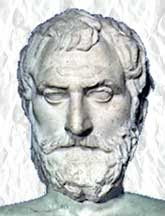
Apparently, Thales was ridiculed for being poor as a result of his pursuit of truth as opposed to wealth. Thales contended that he wasn't concerned with wealth, but he could use his wisdom to achieve wealth if he wanted to. To prove that he wasn't just whistling The Odyssey, he employed his knowledge of astronomy and other observations to determine that there would be a huge crop of olives in the upcoming harvest (How did astronomy play in this calculation? I haven't a clue.). Using what resources he had, Thales then purchased for a small amount of money the right to lease local olive presses during the harvest time. When the huge crop came in as he predicted, Thales cornered the market of olive presses, leased the presses back out at a higher rate, and made a substantial sum of money. Not only was Thales likely the first natural philosopher, he was also likely the first decision analyst.
Not only did I adopt the title "Thales' Press" to refer to this historic use of systematic reasoning to achieve some goal (namely, the acquisition of olive presses to make a bunch of money), I also intend to press the use of the word "Press" to refer to a means of publishing. The publishing being focused on considerations and observations by myself and others (visiting scholar, George P. Burdell, a great American, may contribute on occasion) about decision analysis and decision management.
About Me

- Robert D. Brown III
- Atlanta, Georgia, United States
- I am a senior decision support advisor who provides guidance, deep insights, and valuable solutions for senior decision-makers facing complex, high-risk problems related to strategic planning, risk management, project valuation & planning, and project portfolio analysis & management. My goal is to help people ensure that the decisions they make are well framed (focused on the right problem and clearly defined) and that they understand the implications of uncertainty and risk on the likelihood of achieving their goals.
Recommended Reading
Ask, Inspire, Solve.: The Science and Practice of Facilitative Questioning
 by Katherine Rosback
Bayesian Methods for Hackers: Probabilistic Programming and Bayesian Inference
 by Cameron Davidson-Pilon
Business Case Analysis with R: Simulation Tutorials to Support Complex Business Decisions
 by Robert D. Brown III
Business Portfolio Management: Valuation, Risk Assessment, and EVA Strategies
 by Michael S. Allen
Certain to Win: The Strategy of John Boyd, Applied to Business
 by Chet Richards
Competitive Strategy: Techniques for Analyzing Industries and Competitors
 by Michael E. Porter
Data Analysis: A Bayesian Tutorial
 by Devinderjit Sivia
Decision Analysis for Managers: A Guide for Making Better Personal and Business Decisions
 by David Charlesworth
Decision Analysis for the Professional
 by John Celona and Peter McNamee
Decision Quality: Value Creation from Better Business Decisions
 by by Carl Spetzler, Hannah Winter, and Jennifer Meyer
Decision Traps: The Ten Barriers to Decision-Making and How to Overcome Them
 by Dr. J. Edward Russo and Dr. Paul J. H. Schoemaker
Doing Bayesian Data Analysis, Second Edition: A Tutorial with R, JAGS, and Stan
 by John Kruschke
The Failure of Risk Management: Why It's Broken and How to Fix It
 by Douglas W. Hubbard
The Flaw of Averages: Why We Underestimate Risk in the Face of Uncertainty
 by Sam L. Savage and Jeff Danziger
Foundations of Decision Analysis
 by Ronald A. Howard and Ali E. Abbas
Game Theory 101: The Basics
 by William Spaniel
Game Theory for Business: A Primer in Strategic Gaming
 by Paul Papayoanou
Handbook of Decision Analysis
 by Gregory S. Parnell PhD, Terry Bresnick MBA, Steven N. Tani PhD, Eric R. Johnson PhD
How to Measure Anything: Finding the Value of Intangibles in Business
 by Douglas W. Hubbard
How to Measure Anything in Cybersecurity Risk
 by Douglas W. Hubbard and Richard Seiersen
An Introduction to Bayesian Inference and Decision
 by Robert W. Winkler
Making Hard Decisions: An Introduction to Decision Analysis (Business Statistics)
 by Robert T. Clemen
Mistakes Were Made (but Not by Me): Why We Justify Foolish Beliefs, Bad Decisions, and Hurtful Acts
 by Carol Tavris and Elliot Aronson
Monetizing Your Data
 by Andrew Roman Wells and Kathy Williams Chiang
Moneyball: The Art of Winning an Unfair Game
 by Michael Lewis
Psychology of Intelligence Analysis
 by Richard J. Heuer
Risk Savvy: How to Make Good Decisions
 by Gerd Gigerenzer
The Signal and the Noise: Why So Many Predictions Fail--but Some Don't
 by Nate Silver
Simple Heuristics That Make Us Smart
 by Gerd Gigerenzer, Peter M. Todd, ABC Research Group
Smart Choices: A Practical Guide to Making Better Decisions
 by John S. Hammond, Ralph L. Keeney, Howard Raiffa
The Smart Organization: Creating Value Through Strategic R&D
 by David Matheson, Jim Matheson
Thinking, Fast and Slow
 by Daniel Kahneman
Thinking in Systems: A Primer
 by Donella H. Meadows
Thinking Strategically: The Competitive Edge in Business, Politics, and Everyday Life (Norton Paperback)
 by Avinash K. Dixit, Barry J. Nalebuff
Uncertainty: A Guide to Dealing with Uncertainty in Quantitative Risk and Policy Analysis
 by M. Granger Morgan, Max Henrion, Mitchell Small
Value-Focused Thinking: A Path to Creative Decisionmaking
 by Ralph L. Keeney
Why Can't You Just Give Me The Number? An Executive's Guide to Using Probabilistic Thinking to Manage Risk and to Make Better Decisions
 by Patrick Leach
Why Decisions Fail
 by Paul C. Nutt
You Are Not So Smart: Why You Have Too Many Friends on Facebook, Why Your Memory Is Mostly Fiction, an d 46 Other Ways You're Deluding Yourself
 by David McRaney
You Are Now Less Dumb: How to Conquer Mob Mentality, How to Buy Happiness, and All the Other Ways to Ou tsmart Yourself
 by David McRaney