Tuesday, February 25, 2014

How Do You Know That? Funny You Should Ask.

During a recent market development planning exercise, my client recognized that his colleagues were making some rather dubious assumptions regarding the customers they were trying to address (i.e., acceptable price, adoption rate, lifecycle, market size, etc.), the costs of development, and costs of support. Although he frequently asked “How do you know that?”, he seemed to face irritation and mild belligerence in reaction from those he asked to justify their assumptions. So, together we devised a simple little routine to force the recognition that assumed facts might be shakier than previously thought.

After bringing the development team members together, we went around the room and asked for a list of statements that each believed to be true that must be true for the program to succeed. We wrote each down as a succinct, declarative statement. Then, after everyone had the opportunity to reflect on the statements, we converted each to a question simply by converting the periods to question marks.

Before Western explorers proved that the Earth is round, ships used to sail right off the assumed edges.

We then asked the team to supply a statement that answered each question in support of the original statement. Once this was completed, we then appended the dreaded question mark to each of these responses. We repeated this process until no declarative answers could be supplied in response to the questions. The cognitive dissonance among the team members became palpable as they all had to start facing the uncomfortable situation that what they once advocated as fact was largely unsupportable. Many open questions remained. More uncertainty reigned than was previously recognized. The remaining open questions then became the basis for uncertainties in our subsequent modeling efforts in which we examined value tradeoffs in decisions as a function of the quality of information we possessed. You probably won’t be surprised to learn that the team faced even more surprises as the implications of their tenuous assumptions came to light.

I am interested to know how frequently you find yourself participating in planning exercises at work in which key decisions are made on the basis of largely unsupported or untested assumptions. My belief is that such events happen much more often than we care to admit.

I would also be interested to know if the previously described routine works with your colleagues to force awareness of just how tenuous many preconceived notions really are. I outline the steps below for clarity.
  1. Write down everything you believe to be true about the issue or subject at hand. 
  2. Each statement should be a single declarative statement. 
  3. Read each out loud, forcing ownership of the statement.
  4. Convert each statement to a question by changing the period to a question mark.
  5. Again, read each out loud as a question, opening the door to the tentative nature of the original statement.
  6. Supply a statement that you believe to be true that answers each question.
  7. Repeat the steps above until you reach a point with each line of statements-questions where you can no longer supply answers.
You might find that using a mind mapping tool such as MindNode or XMind are useful for documenting and displaying the assumptions and branching question/responses. The visual display may serve to help your team see connections among assumptions that were not previously recognized.

Let me know if you try this and how well it works.

Wednesday, January 22, 2014

Can Modeling a Business Work?

A friend on LinkedIn asks, “Can modeling a business work?” I respond:

For now, or at least until The Singularity occurs, the development of business ideas and plans is a uniquely human enterprise that springs from a combination of intuition, goals, and ambitions. That should not mean, however, that we cannot effectively supplement our intuition and planning with aids to management and decision making. While I think human intuition is a very powerful feature of our species, I’m also convinced it can be led astray or corrupted by biases very quickly, particularly amid the complexities that arise as plans turn into real life execution. This is not a modern realization. The origin of the principles of inventory management, civil engineering, and accounting date back to the antiquities. Think of the seagoing merchants of the Phoenicians and the public works building Babylonians and Egyptians. In fact, historians now believe that the actual founder of Arthur Andersen LLP was none other than the blind Venetian mathematician and priest, Luca Pacioli (ca. 1494). That's right - that musty odor that emanates from accounting books is due to their being more than 500 years old.

Luca Pacioli doodling circles out of sheer boredom after a day of accounting. I made up the part about his being blind.

Business modeling is a tool similar to accounting in that it aids our thinking in a world whose complexity seems often to exceed the grasp of our comprehension. I look at the value of modeling a business as a means to stress test both the business plan logic and the working assumptions that drive the business plan. In regard to the business plan logic, we're asking if the business has the potential ability to produce the value we think it can; and in regard to the working assumptions, we're testing how sensitively important metrics (i.e., payback time, break-even, required resources, shareholder value) of the business plan respond to conditions in the environment and controllable settings to which our business plan will be subjected.

Obtaining such insights from modeling a business, business leaders can modify business plans by changing policies about pricing, products/services offered, costs targeted for reduction or elimination, and contingency or risk mitigation plans that can be adopted, etc. 

However, I recommend awareness of at least three caveats with regard to business modeling:
  1. Think of such models as "what-ifs" more so than precise forecasts. Use the "what if" mindset to make a business plan more robust against the things outside your direct control versus using it to justify a belief in guaranteed success. The latter is almost a sure fire approach to failure. 
  2. Always compare more than one plan with a model to minimize opportunity costs. Often times, the best business plans derive from hybrids of two models that show how value can be created and retained for at least two different reasons. 
  3. Avoid overly complex models as much as, maybe more so than, overly simplistic models. Building a requisite model from an influence diagram first is usually the best way to achieve this happy medium before writing the first formula in a spreadsheet or simulation tool. Richer, more complex models that correspond to the real world with the highest degree of precision are usually not useful for a number of reasons:
    • they can be costly to build
    • the value frontier of the insights derived decline relative to the cost to achieve them as the degree of complexity increases
    • they are difficult to maintain and refactor for other purposes
    • they are often used to justify delaying commitment to a decision
    • few people will achieve a shared understanding that is useful for collaborating and execution
A requisite model, on the other hand, should deliver clarity and permit making new and interesting testable predictions or reveal insights about, say, uncertainties, that could be made to work in your favor. Admittedly, though, it takes a lot of practice to achieve this third recommendation, but it should be used as a guiding principle.

Sunday, January 12, 2014

Double, double toil and trouble; Fire burn, and caldron bubble

This was a great article in The Wall Street Journal today.

For me, the key take away point can be summed up in this quote from Prof. Goetzmann: "Once people buy in, they start to discount evidence that challenges them..." I relate this not only to investing decisions in the market, but also to making organizational decisions--investments in capital projects, new strategies, the next corporate buzz. We've all seen or been apart of the exuberant irrationality that leads organizations into malinvestments.

Let's consider the complementary action--saying "no." Against the tendency toward the irrational "yes, Yes, YES!", learning to say "no" is a very important skill to master. It's probably one of the hardest skills to master when people request something from us that makes us feel important and liked.

I think, however, we always need to be aware that many of our initial reactions are often driven by biases. Reactively saying "no," once we've learned to say it and it becomes easy to do, can emerge from the same biases that urge us unreservedly to say "yes." Both incur their costs: missed opportunity, waste, and rework.

The skill more important to learn than saying "no" is acquiring the skill to consider disconfirming evidence, especially when that evidence challenges our dearest assumptions about what is going to make us rich. Let's not be so quick to say "yes" or smug when we say "no." Rather, let's learn the practice of asking,
  • "what information might disabuse me of my favorite assumptions?"
  • "what biases are preventing me from seeing clearly?"
Failing to learn these, we all too often find ourselves concocting a witches' brew.

Tuesday, September 10, 2013

It's Your Move: Creating Valuable Decision Options When You Don't Know What to Do

The followings is the first chapter excerpt from my newly published tutorial.

Business opportunities of moderate to even light complexity often expose decision makers to hundreds, if not tens of thousands, of coordinated decision options that should be considered thoughtfully before making resource commitments. That complexity is just overwhelming! Unfortunately, the typical response is either analysis paralysis or "shooting from the hip," both of which expose decision makers to unnecessary loss of value and risk. This tutorial teaches decision makers how to tame option complexity to develop creative, valuable decision strategies that range from "mild to wild" with three simple thinking tools.


Read more here.

Wednesday, July 24, 2013

RFP Competitive Price Forecasting Engine

Developing a competitive price in response to an RFP is difficult and fraught with uncertainty about competitor pricing decisions. "Priced to Win" approaches often lead to declining margins. Our approach and tool set allow you to develop a most likely price neutral position that helps you focus more attention on providing "intangible" benefits that differentiate your offering in a way that is more valuable to your potential client.

Tuesday, July 23, 2013

Business Case Analysis with R

The following is the first chapter excerpt from my newly published book.

Business Case Analysis with R

A Simulation Tutorial to Support Complex Business Decisions


1.2 Why use R for Business Case Analysis?
Even if you are new to R, you most likely have noticed that R is used almost exclusively for statistical analysis, as it's described at The R Project for Statistical Computing. Most people who use R do not frequently employ it for the type of inquiry which business case analysts use spreadsheets to select projects to implement, make capital allocation decisions, or justify strategic pursuits. The statistical analysis from R might inform those decisions, but most business case analysts don't employ R for those types of activities.

Obviously, as the title of this document suggests, I am recommending a different approach from the status quo. I'm not just suggesting that R might be a useful replacement for spreadsheets; rather, I'm suggesting that better alternatives to spreadsheets be found for doing business case analysis. I think R is a great candidate. Before I explain why, let me explain why I don't like spreadsheets.

Think about how a spreadsheet communicates information. It essentially uses three layers of presentation:
  1. Tabulation
  2. Formulation
  3. Logic
When we open a spreadsheet, usually the first thing we see are tables and tables of numbers. The tables may have explanatory column and row headers. The cells may have descriptive comments inserted to provide some deeper explanation. Failure to provide these explanatory clues represents more a failing of the spreadsheet developer's communication abilities than a failing of the spreadsheet environment, but even with the best of explanations, the emergent pattern implied by the values in the cells can be difficult to discern. Fortunately, spreadsheet developers can supply graphs of the results, but even those can be misleading chart junk.

To understand how the numbers arise, we might ask about the formulas. By clicking in a cell we can see the formulas used, but unfortunately the situation here is even worse than the prior level of presentation of tables of featureless numbers. Here, we don't see formulas written in a form that reveals underlying meaning; rather, we see formulas constructed by pointing to other cell locations on the sheet. Spreadsheet formulation is inherently tied to the structural presentation of the spreadsheet. This is like saying the meaning of our lives should be dependent on the placement of furniture in our houses.

While the goal of good analysis should not be more complex models, a deeper inquiry into a subject usually does create a need for some level of complexity that exceeds the simplistic. But as a spreadsheet grows in complexity, it becomes increasingly difficult to extend the size of tables (both by length of indices that structure them and the number of indicies used to configure the dimensionality) as a direct function of its current configuration. Furthermore, if we need to add new tables, choosing where to place them and how to configure them also depends almost entirely on the placement and configuration of previously constructed tables. So, as the complexity of a spreadsheet does increase, it naturally leads to less flexibility in the way the model can be represented. It becomes crystalized by the development of its own real estate.

The cell referencing formulation method also increases the likelihood of error propagation because formulas are generally written in a quasi-fractal manner that requires the formula to be written across every element in at least one index of a table's organizing structure. Usually, the first instance of a required formula is written within one element in the table; then, it is copied to all the appropriate adjacent cells. If the first formula is incorrect, all the copies will be, too. If the formula is sufficiently long and complex, reading it to properly debug it becomes very difficult. Really, the formula doesn't have to be that complicated or the model that complex for this kind of failure to occur, as the recent London Whale VaR model and Reinhart-Rogoff Study On Debt debacles demonstrated.[1]

All of this builds to the most important failure of spreadsheets -- the failure to clearly communicate the underlying meaning and logic of the analytic model. The first layer visually presents the numbers, but the patterns in them are difficult to discern unless good graphical representations are employed. The second layer, which is only visible unless requested, uses an arcane formulation language that seems inherently irrational compared to the goal of good analysis. The final layer--the logic, the meaning, the essence of the model--is left almost entirely to the inference capability of any user, other than the developer, who happens to need to use the model. The most important layer is the most ambiguous, the least obvious. I think the order should be the exact opposite.

When I bring up these complaints, the first response I usually get is: "ROB! Can't we just eat our dinner without you complaining about spreadsheets again?" But when the population of my dinner company tends to look more like fellow analysts, I get, "So what? Spreadsheets are cheap and ubiquitous. Everyone has one, and just about anyone can figure out how to put numbers in them. I can give my analysis to anyone, and anyone can open it up and read it."

Then I'm logically--no, morally--compelled to point out that carbon monoxide is cheap and ubiquitous, that everyone has secrets, that just about everyone knows how to contribute to the sewage system, that just about everyone can read your diary and add something to it. Free, ubiquitous, and easy to use are all great characteristics of some things in their proper context, but they aren't characteristics that are necessarily universally beneficial.

More seriously, though, I know that what most people have in mind with the common response I receive is the low cost of entry to the use of spreadsheets and the relative ease of use for creating reports (which I think spreadsheets are excellent for, by the way). Considering the shortcomings and failure of spreadsheets based on the persistent errors I've seen in client spreadsheets and the humiliating ones I've created, I think the price of cheap is too high. The answer to the first part of their objection--spreadsheets are cheap--is that R is free. Freer, in fact, than spreadsheets. In some sense, it's even easier to use since the formulation layer can be written directly in a simple text file without intermediate development environments. Of course, R is not ubiquitous, but it is freely available on the internet.

Unlike spreadsheets, R is programming language with the built in capacity to operate over arrays as if they were whole objects, a feature that demolishes any justification for cell-referencing syntax of spreadsheets. Consider the following example.

Suppose we want to model a simple parabola over the interval (-10, 10). In R, we might start by defining an index we call x.axis as an integer series.

x.axis <– -10:10

which looks like this,

> [1] -10  -9  -8  -7  -6  -5  -4  -3  -2  -1 0  1  2  3  4  5  6  7  8  9  10

when we call x.axis.

To define a simple parabola, we then write a formula that we might define as

parabola <– x.axis^2

which produces, as you might now expect, a series that looks like this:

>[1] 100  81  64  49  36  25  16  9  4  1  0  1  4  9  16  25  36  49  64  81 100.

Producing this result in R required exactly two formulas. A typical spreadsheet that replicates this same example requires manually typing in 21 numbers and then 21 formulas, each pointing to the particular value in the series we represented with x.axis. The spreadsheet version produces 42 opportunities for error. Even if we use a formula to create the spreadsheet analog of the x.axis values, the number of opportunities for failure remains the same.

Extending the range of parabola requires little more than changing the parameters in the x.axis definition. No additional formulas need be written, which is not the case if we needed to extend the same calculation in our spreadsheet. There, more formulas need to be written, and the number of potential opportunities for error continues to increase.

The number of formula errors that are possible in R is directly related to the total number of formula parameters required to correctly write each formula. In a spreadsheet, the number of formula errors is a function of both the number of formula parameters and the number of cell locations needed to represent the full response range of results. Can we make errors in R-based analysis? Of course, but the potential for those errors is exponentially smaller.

As we've already seen, too, R operates according to a linear flow that guides the development of logic. Also, variables can be named in a way that makes sense to the context of the problem[2] so that the program formulation and business logic are more closely merged, reducing the burden of inference about the meaning of formulas for auditors and other users. In Chapter 2, I'll present a style guide that will help you maintain clarity in the definition of variables, function, and files.

However, while R answers the concerns of direct cost and the propagation of formula errors, its procedural language structure presents a higher barrier to improper use because it requires a more rational, structured logic than is required by spreadsheets, requiring a rigor that people usually learn from programming and software design. The best aspect of R is that it communicates the formulation and logic layer of an analysis in a more straightforward manner as the procedural instructions for performing calculations. It preserves the flow of thought that is necessary to move from starting assumptions to conclusions. The numerical layer is presented only when requested, but logic and formulation are more visibly available. As we move forward through this tutorial, I'll explain more how these features present themselves for effective business case analysis.

1.3 What You Will Learn
This document is a tutorial for learning how to use the statistical programming language R to develop a business case simulation and analysis. I assume you possess at least the skill level of a novice R user.

The tutorial will consider the case in which a chemical manufacturing company considers constructing a new chemical reactor and production facility to bring a new compound to market. There are several uncertainties and risks involved, including the possibility that a competitor brings a similar product online. The company must determine the value of making the decision to move forward and where they might prioritize their attention to make a more informed and robust decision.

The purpose of the book is not to teach you R in a broad manner. There are plenty of resources that do that well now. Rather, it will attempt to show you how to

  • Set up a business case abstraction for clear communication of the analysis
  • Model the inherent uncertainties and resultant risks in the problem with Monte Carlo simulation
  • Communicate the results graphically
  • Draw appropriate insights from the results
So, while you will not necessarily become a power user of R, you will gain some insights into how to use this powerful language to escape the foolish consistency of spreadsheet dependency. There is a better way.

1.4 What You Will Need
To follow this tutorial, you will need to download and install the latest version of R for your particular OS. R can be obtained here. Since I wrote this tutorial with the near beginner in mind, you will only need the base install of R and no additional packages.


Notes
1: You will find other examples of spreadsheet errors at Raymond Panko's website. Panko researches the cause and prevalence of spreadsheet errors.

2: Spreadsheets allow the use of named references, but the naming convention can become unwieldy if sections in an array need different names.


Read more here: Or, if you prefer Amazon or Scribd.

Wednesday, March 06, 2013

Never Tell Me The Odds?

In a previous post, I discussed the meaning of expected value (EV) and how it's useful for comparing the values of choices we could make when the outcomes we face with each choice vary across a range of probabilities. The discussion closed by comparing the choice to play two different games, each with different payoffs and likelihoods. Game 1 returns an EV of $5, even though it could never actually produce that outcome; and Game 2 returns an EV of $4, also being incapable of producing that outcome.

But let's say that you hate it when C-3PO tells you the odds, so you commit to Game 2 because you like the upside potential of $15, and you think the potential loss of $5 is tolerable. After all, Han Solo always beat the odds, right? Well, before you so commit, let me encourage you to look into my crystal ball to show you what the future holds…not just in one future, but many.

Figure 1: Han Solo shakes his finger.
C-3PO: “Sir, the possibility of successfully navigating an asteroid field is approximately 3,720 to 1.”
Han Solo: “Never tell me the odds.”
I set up an Analytica model with the following characteristics. A sequence index (Play Sequence) steps from 1 to 1,000. Over this index I will toss two "coins," one with Probability of Win of 50% (Game 1), and the other (Game 2) with Probability of Win of 45% according to the way I set up the game in my last post. Each Game tosses the coin independently across the Play Sequence, recording the outcome on each step. A Game Reward ($10 for Game 1; $15 for Game 2) is allocated to a win, and a Game Penalty ($0 for Game 1; -$5 for Game 2) is allocated to a loss. Then, I cumulate the net Game Earnings across the Play Sequence to show on what value the cumulative earnings might converge for many repeated games choices. Not only do I play the games over 1000 sequence steps, I also play the sequences across 1000 universes of parallel iterations. From this point forward, I will refer to an "iteration" as the pattern that occurs in one of these parallel universes across the 1000 games it plays in sequence.
Figure 2: Analytica Influence Diagram. After each game step, wins are assigned a reward; losses, a penalty. Net returns are accrued.
What do we observe? In one iteration, we see you start off accruing net earnings in excess of the higher valued Game 1 across the first 400 or so games; however, your luck turns. You end up regretting not taking Game 1.
Figure 3: A streak of early wins can deceive your long term anticipations.
In another iteration, you marginally regret not taking Game 1. You can easily imagine that the outcome could be slightly reversed from this, finding yourself happy that Game 2 just beat out Game 1. Would that outcome prove anything about your skill as a gambler?
Figure 4: You might come close to beating the odds. It appears conceivable that you can. Maybe your luck will turn in the next game you play.
But of course, your luck might turn out much worse. In another iteration, you really regret your bravado.
Figure 5: Yikes!
"Of course," you say, "because the probabilities tell me that I might expect some unfortunate outcomes as well as some beneficial ones. But what overlap might there be over all the iterations at play? Is there some universe in which the odds ever really are in my favor?"

Here's what we see. For Game 1, the accrued earnings range from ~$4,500 to ~$5,500 by the 1000th step.
Figure 6: the accrued earnings range from ~$4,500 to ~$5,500 by the 1000th step for Game 1.
For Game 2, the accrued earnings range from ~$3,000 to ~$5,100. Clearly, some overlap potential exists out there.
Figure 7: the accrued earnings range from ~$3,000 to ~$5,100 for Game 2.
In fact, in the early stages of the game sequences, the potential for overlap appears to be significant, and there seems to be a set of futures where the overlap persists. You might just make that annoying protocol droid wish he had silenced his electronic voice emulator.

But take a second look. That second-from-the-top band for Game 2 converges on the second-from-the-bottom band in Game 1. These are the upper and lower 5th percentile bands of the outcome, respectively.
Figure 8: The final distributions of the two games shows that there are some universes in which your luck holds up...a very small amount of up.
When we count how likely it is that Game 2 ends in winning conditions at various intervals points along the way, the perceived benefit in the higher potential reward of Game 2 decays rapidly. Before you even start, the chance that you could be in a better position by step 1000 for taking Game 2 is around half a percent.
Figure 9: The long-term perspective of maintaining a winning position in decays rapidly for Game 2.
In the model, note that the average earnings by step 1,000 for Game 1 is $5,000 (i.e., 1000*EV1) and that the earnings for Game 2 is $4,000 (i.e., 1000*EV2). It's as if the imputed EV of each game inexorably accumulated over time…a very long time and over many universes.

So it is in the fantasy of Hollywood that the mere mention of long odds ensures the protagonist's success. Unfortunately, life doesn't always conform to that fantasy. Over a long time and many repeated occasions to play risky games, especially those that afford little opportunity to adjust our position or mitigate our exposure, EV tells us that our potential for regret increases for having chosen the lesser valued of the two games. Depending on the relative size of the EVs between the two choices, that potential for regret can occur rapidly as the inherent outcome signal implied by the EV begins to overwhelm the potential short-term lucky outcomes in the random noise of the game.

So how can you know when you will be lucky? You can't. The odds based on short-term observations of good luck will not long be in your favor. Your fate will likely regress to the mean.

(This post was also simultaneously published at the Lumina Blog.)

Wednesday, February 27, 2013

Will You Be Mine?

Business is not war. In fact, I'm getting tired of the trope that relies on this analogy. I think it's destructive and counterproductive - just like war.

I can understand the attractiveness of the metaphor as business sometimes looks like its getting all Lord of the Flies. Companies come and go, apparently succumbing to the forces of competition. Profits are made and lost. People's jobs, like lives on a battlefield, are on the line. Kill or be killed. It all frequently feels like a zero sum game.

And war usually is a zero sum game. One side wins and the other side loses. Well, I'm not even sure that is entirely accurate. War involves losses on both sides, the value of which may actually exceed the estimated value of going to war. In the cases of so called Pyrrhic Victories, the victor simply cannot afford to keep engaging in excursions of conquest. Martial conquest does not guarantee profit.

But as similar as business can seem to war, business is not quite the same. Sure, competition is ever present. Contracts are violated. Deals fail to close or are lost to another offeror. There's espionage and subterfuge. But whereas war usually involves two fronts—red versus blue, Joe versus Charlie, Allied versus Axis—business involves at least three fronts: you, the competition, and your customers.

In war, the primary focus rests on the competition, and the goal is to eliminate them, either by all out destruction or by dousing their will to contend. In war, one side usually surrenders to the other. But this is really not the case in business. The primary goal is not to eliminate the competition (it may be counterproductive to do so), but to win the attention of your customers. The real goal of business is to make a transaction in which at least two sides mutually benefit more than if no transaction occurred. The competition is present, and possibly corrosive, but it's not the primary concern.

The competition itself may evolve and satisfy needs and preferences that your own offerings don't satisfy. And so, in this way, business works out to be something more like a complex ecosystem of niche partitioned agents who are seeking to sustain their ability to generate ongoing profitable transactions. And yet it's not so much White Fang as much as it is…well…Pride and Prejudice. (Do I lose my man card for saying that?)

That's right. I think the best metaphor for business is romance in which we as suitors vie for the attention of our beloved—the customer. Again, the competition is there, but it's not our primary concern. We have to learn to deal with it and respond to it; however, if our attention on the competition dominates our activities versus our attention on our customers, current and potential, we may wind up winning a fight but losing our reason for existence, like two boys fighting it out in the school yard over a girl who walks away in disgust.

There is so much more to long term success than revenue generation. But success doesn't happen because we have no competition. Success happens because we provide something that satisfies a need better than the alternatives, even if one of those alternatives is nothing more than what our customers are already doing. What those real needs and preferences are is often hard to identify, but we don't find those out by going to war. We discover them the way lovers learn to fulfill each other's needs. While war is dehumanizing and often provides the psychological barriers that permit actions against others we would normally never consider, romance is about fulfillment.

Let me close with this quote from Marc Hedlund's Blog, in which Marc discloses his thoughts on closing his company, Wasabi:
You can't blame your competitors or your board or the lack of or excess of investment. Focus on what really matters: making users happy with your product as quickly as you can, and helping them as much as you can after that. If you do those better than anyone else out there you'll win.

Monday, February 18, 2013

Fooling Ourselves

For some peculiar reason, this NPR article brought back memories of when I was a math and physics teacher.  One of the several perennial questions my students used to ask me was, "When will we ever use this, Mr. B.?" Of course, there was always, "Will this be on the test?"

One of my standard responses to the first question (the second usually received a scowl) was that mathematics (insofar as it is actually useful) provides a great tool for determining if you're being cheated. Learning to use it effectively increases our ability to avoid becoming someone else's stooge.

But the NPR article serves to remind us that often the greatest threat to being cheated comes from within. We all need to learn the "algebra" that helps us overcome our own internal scam.

Tuesday, February 12, 2013

Incite!Sales: Sales Portfolio and Forecasting System

Sales forecasts are notoriously biased, which leads to misallocation of resources and financial surprises. Our sales portfolio & forecasting system removes bias from forecasts to give you a more accurate view of your sales reality so that you can make more informed decisions about opportunities to pursue. http://incitesales.incitedecisiontech.com

Thursday, February 07, 2013

A Brief Explanation of Expected Value

When helping people analyze the risks they face in complex decisions, I frequently receive requests for an explanation of expected value, as expected value is a measure commonly used to compare the value of alternate risky options. I’ve found that by now most people understand the concept of net present value (NPV) rather well, but they still struggle with the concept of expected value (EV)*. Interestingly enough, and fortunately so, the two concepts share some relationship to each other that makes an explanation a little simpler.

NPV is the means by which we consistently compare cash flows shaped differently in time, assuming that money has a greater meaning to us when we get it or spend it sooner rather than later. For example, NPV would help us understand the relative value of a net cash stream that experienced a small draw down in early periods but paid it back in five years versus a net cash stream that makes a larger draw down in early periods but pays it back in three years.

EV is similar. By it we consistently compare future outcome values that face different probabilities of occurring.

When we do NPV calculations, we don’t anticipate that the final value in our bank account necessarily will equal the NPV calculated. The calculation simply provides a way to make a rational comparison among alternate time-distributed cash streams.

Likewise, when we do EV calculations, we don’t anticipate that the realized value necessarily will equal the EV. In fact, in some cases it would be impossible for that outcome to be the case. EV just simply provides a way to make a rational comparison among alternate probability-distributed outcomes.

Here’s a simple example. Suppose I offer you two gambles to play in order to win some money. (Not really, of course, because the State of Georgia reserves the right to engage in games of chance but prohibits me from doing so.)

In the first game, there are even odds (probability=50%) that you will win either $10 on the outcome of a head or $0 on a tail.

In the second game, which is a little more complicated, I use a biased coin for which the odds are slightly less than even, say, 9:11 (probability=45%), of your winning. If you win, you gain $15; lose, you pay me $5. Which is the better game to play? Believe it or not, the answer depends on how you frame the problem, most notably from your perspective of risk tolerance and how many games you get to play. If you can’t afford to pay $5 if you lose the second game on the first toss, you’re better off to go with the first game because you will lose nothing at least and gain $10 at best. However, if you can afford the possible loss of $5 and you can play the game repeatedly over numerous times, expected value tells us how to compare the two options.

We calculate EV in the following way: EV = prob(H)*(V|H) + prob(T)*(V|T).

For the first game, EV1 = 0.5*($10) + 0.5*(0) = $5.

For the second game, EV2 = 0.45*($15) – 0.55*($5) = $4.

So, since you prefer $5 over $4 (you do, don’t you?), you should play the first game, even though the potential maximum award is alluringly $5 more in game two than one.

But here's the point about the outcomes. At no time in the course of playing either game will you have $5 or $4 in your pocket. Those numbers are simply theoretical values that we use to make a probability-adjusted consistent comparison between two risky options.

In a follow up post, I will describe what your potential winnings could look like if you choose to play either game over many iterations across many parallel universes.

*To be honest, I think part of the persistent problem in understanding is contributed by the term "expected" itself. Colloquially, when people use and hear this term, they think "anticipated." In discussions about risk and uncertainty, the technical meaning really refers to a probability weighted average or mean value. Unfortunately, I don't expect that you should wait for us technical types to accommodate common usage. [back]

Tuesday, January 15, 2013

Getting the Lead Out - of Poor Thinking

New research finds Pb is the hidden villain behind violent crime, lower IQs, and even the ADHD epidemic. And fixing the problem is a lot cheaper than doing nothing.
-"America's Real Criminal Element: Lead"
I'm inclined to believe the recent news (critique, rebuttal) about lead poisoning being the primary culprit in the cause of the crime wave from the 1960s through the 1990s will prove out.

But I'm a spectator here. Notwithstanding the commitment to my current convictions, I do think more study should be pursued to find disconfirming evidence to determine just how strong this hypothesis really is. See, I do not want to believe something is true because I've been convinced it's true. I want to believe because all other alternative explanations have been excluded either by logic or evidence. I hope we're all properly skeptical in this way because the value of removing hypotheses that don't explain the data well might, as is indicated in "America's Real Criminal Element: Lead," prove immensely valuable.

However, I think there is something else for us all to learn here, not just about the pernicious effect of lead in the environment, but also about the toxic effects of bias in our thinking, planning, and policy making and the long term effects of them.

As you read the three linked articles above, ask yourself:
  • How often do we insist that we know, know beyond a shadow of a doubt, the cause of some puzzling event because of our ideology, superstitions, or by confusing causation with correlation? 
  • Similarly, how often do we consider just how ignorant we really are, completely unaware of hidden variables at work beneath the façade of preconceived notions? 
  • How often do we take credit or assign credit to our heroes for desired outcomes on the heels of decisive action when good luck is probably just as good an explanation? 
  • Or conversely, how often do we blame ourselves or others for undesirable outcomes when bad luck is also probably just as good an explanation?
...we all have a deep stake in affirming the power of deliberate human action.
There is power in knowing, but there is also power in being aware of just how little we know. And that might prove to be more valuable.

Got Correlation?

And now for your daily correlation versus causation alert.

Countries whose people drink more milk win more Nobel prizes, according to research published Tuesday in Practical Neurology, a serious British journal. It builds on research last year in the New England Journal of Medicine that found a nearly identical link between chocolate consumption and Nobel success.
This is good to know, because I drank chocolate milk every day for lunch from first grade through high school. Of course, it was government milk, so the benefits may not translate to me.

Friday, January 11, 2013

So, What Is Your Algorithm?


I thought this story about Schwan’s was interesting for this reason: a 3-4% improvement on revenues of ~$3 billion (2010 Annual report) over less than one year didn’t feel that significant to me.  In fact, if you look at it this way, Schwan’s improved sales by 3.5% * $3billion/3million purchasers = $35/purchaser.  That’s two additional entrees, or 5 additional pizzas, per customer over 1 year!

The 3-4% improvement over 1 year doesn’t mean, either, that Schwan’s will maintain annual revenue growth of 3-4%, especially if their customer base doesn’t grow.  In fact, according to their 2011 Annual Report, revenues remained at the ~$3 billion level as 2010. So what I see here, in the limited amount of information in this story, is that Schwan’s system lifted sales to make their fleet incrementally more efficient.

Average inflation for 2011 was reported to be 3.2%. (See "Table of Inflation Rates by Month and Year (1999-2012)")  I would be interested to know if Schwan’s own expenses grew at the inflation rate.  If so, Schwan’s merely kept up with inflation through 2011.

Depending on the cost of the system, the system may have made sense from a stand alone ROI perspective.  Call me skeptical, though, but this doesn’t feel like a sustainable game changing improvement at Schwan’s. I hope the story is different for Schwan's one year down the road from the original publication date of this article.

All that aside, I’m not sure this is a good example of avoiding the kinds of decision/thinking failures that Daniel Kahneman talked about because it seems to me the Schwan’s fleet is simply getting a little bit better information about how to implement an existing strategy, as opposed to Schwan’s avoiding the kinds of biases that make people pick the wrong strategy. Maybe that’s the real story here – Schwan’s let the siren song of advanced technology convince them to continue following a margin sensitive strategy to 1 (!) more decimal place.  They are solving the wrong problem with increasing precision. In fact, this story about Schwan’s isn’t really consistent with the Moneyball story of Billy Beane and the Oakland A’s.  In that example, Billy Beane and Paul Podesta challenged long held beliefs about the value of players’ capabilities, tested their own hypotheses, and bought the resources they needed to win at bargain rates.  They weren’t just squeezing more runs out of superstar players.  They found value where everyone else who esteemed themselves as experts said that it couldn’t be found.  The effect was actually, pardon the pun, game changing for the A’s.  They were no longer building a baseball team or playing baseball the way everyone else said that it had to be managed and played.  They became a uniquely good team versus being a team that tried only to improve within notions of conventional wisdom with declining marginal returns for the effort.  Did they use statistical analysis to do their job? Yes, but I think they really only needed the statistical analysis to indicate the presence of an inefficiency in the baseball marketplace, and then to find the resources they needed. They formulated and pursued a strategy around this idea of exploiting information inefficiencies.

What does this mean for us —those of us who desire to be better at making more valuable and creative decisions or helping others in that endeavor?  First, in the age of Big Data, I think we need to be careful about showcasing Big Data applications as examples of how decision analysis methodologies work.  The story about Schwan’s in this article is an application of data analytics and information technology that gleaned narrow improvements from statistical information, not necessarily good creative decision making.  We need to be careful about the distinction in what some people are calling applications of decision science and what we do with decision analysis and management.  I don’t doubt that the Opera solution is doing advanced analytics. I just doubt that Schwan’s engaged in good decision making. :/

What I see that valuable decision analysis provides is a mindset, a meta-system, to avoid the kind of system 1 (biased intuition) and system 2 failures (intellectual laziness) that Kahneman describes. A thorough application of decision analysis should consider multiple alternate strategies to achieve something more than incremental improvements.  With decision analysis we should seek disconfirming evidence and logic for biased assumptions.  Decision analysis of the kind I think we want to do avoids cognitive inefficiencies that arise from cognitive and motivational biases, information that has been aggregated at too gross of a level, and creative laziness. The questions we ought to help the consumers of our thinking answer are not just whether they need better information systems, but whether, for example, a better information system is the best application of resources to achieve game changing returns.  I think this kind of thinking leads to qualitatively different kinds of question.  I’m not saying that advanced data analysis can’t be powerful. We know that it can be.  But it might not always be the best solution.

Sunday, December 23, 2012

A Mathematician's Lament


A Mathematician's Lament
A good problem is something you don’t know how to solve. That’s what makes it a good puzzle, and a good opportunity. A good problem does not just sit there in isolation, but serves as a springboard to other interesting questions. -Paul Lockhart

Wednesday, December 05, 2012

Odd Couples: How Ice Skaters and Fireflies Tell Us Something About the Language of the Universe

The universe has always possessed the language it needs to conduct its own affairs. I don’t think it could be otherwise.

Because my daughter participates in competitive figure skating, my wife and I spend a lot of time at the ice rink. Well, to be accurate and fair, my wife spends a lot of time at the ice rink.

Today is different. The recent Thanksgiving holiday activities disrupted regular free skate schedules, so I volunteered to take my daughter this morning to the special free skate sessions that were offered at the rink. Sitting in the upper bleachers where the air is a little warmer, if only marginally so, I watch the disorder on the ice below. Kids and adults are everywhere, all over the ice working off the sumptuousness of recent holiday dinner and desserts and pent up energy from confinement with their relatives. It’s interesting to observe the range of skills present on the ice. As some cling desperately to the walls, others confidently glide and spiral and pirouette with grace. The ice buzzes with activity.

I’ve observed this scene dozens of times before, but suddenly it takes on an otherworldly appearance to me. Sitting high above on my cold perch, I feel a strange detached sensation, imagining myself as something like a Martian scientist observing the behavior of some recently discovered phenomenon on the blue-green planet out there. The icelings with metal blades attached to two of their appendages hurtle around in a cage paved with ice in utter chaos. But there’s something about the chaos that piques my interest. I observe no traffic directing signals, no marked or structured lanes, no apparent communication; yet, each ice-blader seems to adjust its position, speed, and direction to avoid hitting the other ice-bladers. What once appeared as chaos now seems to have a pattern or structure to it. Although I can’t seem to predict where any of the ice-bladers will be over time, I seem to be able to predict something that feels oddly important: no collisions will occur in the time window of my observations. The chaos I observe is not like the random collision-prone molecules in the rarified atmosphere of Mars. Rather, a self-emerging order of collision avoidance becomes apparent. With my dispassionate optical sensors, I can’t say I’m observing a social system of cooperation; however, a system of coordinated communication definitely seems to be occurring by which the entities below me dynamically adjust their physical state without centralized guidance or premeditated design (like that we expect to see in pair skating or synchronized swimming).

Thursday, August 23, 2012

Economists Are Overconfident. So Are You

HBR blogger, Justin Fox, provides a great explanation in "Economists Are Overconfident. So Are You" for why you need to report insights with graphs, not just numbers or even no numbers at all. Here's the key take-away for you:
They paid too much attention to the averages, and too little to the uncertainties inherent in them, thereby displaying too much confidence.

Wednesday, August 22, 2012

Hypothesis Driven vs. Data Driven Analytics

We're having an excellent discussion at the LinkedIn discussion group
Advanced Business Analytics, Data Mining and Predictive Modeling on the topic of
"Hypothesis Driven Vs. Data Driven Analysis - Which do you support? Throw it all in the black box (computational) and see what you get or lets define the problem and seek data to analyze (traditional)."

If you have thoughts or guidance on this, you ought to join us or comment here.

Monday, August 06, 2012

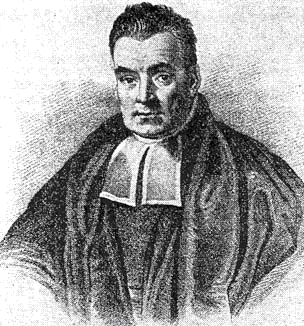
Fear and Loathing in Las Vegas with Reverend Bayes

A trip to Vegas, an evil clown, a bizarre coin, and a minister. What could go wrong?

I commented in a footnote of an earlier post that one of my favorite – no, morally obligated – questions to ask when faced with imposing assertions or risky plans is: “How do you know that?” If we could but practice the discipline to ask this question more often with greater courage and rigor, I think it would lead us to less intrusive and ineffective public policy decisions, assertions of power over those we distrust, or costly commitments to action based solely on untested gut feel or intuition alone.

Please, don’t misunderstand me. I think intuition or gut feel plays a very important place in many areas of life, including business, science, mathematics, policy making, cooking, career choices, and a hundred more. In fact, I’m pretty sure that all progress and innovation occurs, in part, because of an initial intuition or hunch that arises in the mind of an interested inquirer. The question, though, is what do we do with such a hunch when we face critical or risky decisions? Do we Farragut ahead without regard to the possible risks, damning the torpedoes, or do we attempt to answer the question, “How do I know that?” and consider the implications of our intuition before we act?

Reverend Thomas Bayes: evil clown fighter.

Fortunately, we have a tool, Bayes’ Theorem (named after the Reverend Thomas Bayes, who left this intellectual gem behind after his death in 1761), to integrate our intuition and systematic inquiry in a logically powerful way. Read more...

Dare to Disagree

I thought this TED talk by Margaret Heffernan was great and complementary to the blog post I wrote: Ain't I Got a Right to be Wrong?

Sunday, July 08, 2012

Overcoming the Limits on Job Markets

Kenneth Anderson wrote a provocative post at the Volokh Conspiracy entitled "Limits on Job Market for Scientists and STEM (and Why, in an Alternative Universe Not Consisting of Our Universities, You Should Also Study Humanities)."

This is my contribution to the discussion:
I majored in mechanical engineering, but I spent considerable time in elective courses on philosophy of science and American literature. I believe the combination gave me a rounder view of the world, taught me multiple disciplines of critical analysis, and prepared me to communicate effectively. I also think those integrated, cross disciplinary skills made me broadly employable as I've enjoyed being a teacher, an engineer, a marketeer, a strategist, and a consultant - most of the time in a lucrative manner (well, except the teaching, but I loved being a teacher, even as my waistline got thinner). However, I do think the engineering degree conferred an edge to my employability that a humanities degree alone would not have.

Looking back even further than engineering school, I'd have to say that it was my peculiar constitution, not the probability of employment, that lead me there. I never conceived of being anything but an engineer, and I'm not sure I would be happy pursuing anything else but engineering of some kind.

Today I have two high school boys, both of whom are bright, studious, disciplined, and creative, yet neither of them has a technical bone in their body. Their heads and hearts are firmly oriented to the humanities. While I cringe at the prospect of supporting them financially until they are 40, I also struggle with directing them toward a STEM related field knowing that without a passion or aptitude for it, they likely will not do their best, most creative, valuable work. So many of my colleagues vocally express hatred for their jobs because they were directed there through the employability argument. Their discontent expresses itself beyond words. While the rate of employment and initial salaries in STEM fields may be higher than in the humanities, putting aside the usual cynicism about success, a real interest in a field confers a comparative advantage that ultimately distinguishes career leaders from job seekers.

So now I encourage my boys not only to find their passion, but also to find a problem or unmet need in that field and develop a niche business around that. In other words, by developing an entrepreneurial mindset along with their chosen field of study, they hopefully will find a strategic improvement over the prior probability of finding employment with a humanities degree. My next door neighbor exemplifies these combined attributes. With dual undergraduate degrees in professional writing and Russian and a MBA, she now runs a very successful business writing & PR company. I know of several other examples similar to hers in which, finding themselves at odds with the reigning view of unemployability, they created their own employment, not just for themselves, but many others.

Entrepreneurship seems to be the missing ingredient in practically all the education and career guidance I see. I'm not sure that we necessarily ought to steer young people toward the fields that are currently the most commercially viable, simply because the demand might not sustain across the time horizon required to prepare for it, not everyone's interests and aptitudes will align with it, and being a job seeker is usually not (by my way of thinking, admittedly) the most fulfilling and productive way to live one's life or contribute significantly to culture. Right now I am convinced that learning to be an entrepreneur in whatever field of interest one has provides the greatest opportunity to overcome those prior limitations. Both STEM and humanities oriented education seem woefully absent of this guidance.

Monday, July 02, 2012

Desperately Diving for Pearls of Great Price

You would be shocked to learn how fast you can make it to the bottom of a lake with a cinder block tied to your leg. I know this rate, by my own empirical investigation, to be thirty feet per second, give or take. If you’re in the mind to disconfirm this experimentally determined value, I will tell you how to repeat this experiment for yourself. First, convince yourself there are freshwater pearls in the mussels that live in your grandfather’s lake…

This is an example of the fresh water pearl mussel.  I never found any. If you aren't careful, you might, too.
Read more here.

(Image obtained from http://upload.wikimedia.org/wikipedia/commons/e/ed/Margaritifera_margaritifera-buiten.jpg)

Saturday, June 02, 2012

Ain’t I Got a Right to be Wrong?

When the words came tumbling out of my mouth,
I felt it all goin’ south,
But I kept on talkin’
‘Til you started walking.
Now I’m trying to dig my way out.
Ain’t I got a right to be wrong?
I was a whiz kid in college. You know, the kind of kid my professors wanted to whiz on. The reason: I was quick to argue, often too quick. College presented a very competitive environment to me. Rather than learn from others who actually knew better and had something to teach me, I often let myself get caught in the trap of thinking that competitive posturing would advance my career. I know now that never happens in the business environment among mature adults, but in the mind of a sophomore engineering student surrounded by thousands of people all competing for grades and corporate placement, winning seemed like a fine goal to have in mind.  #winning

Read more here...

Thursday, May 24, 2012

An Elite Group of Stratospheric Thinkers

Peace. Love. War. Sex. Money. Life. Death. These are some of the most important issues we all deal with in more reflective and philosophical moments.

Oh yeah, and a good shave. Let me explain: I know the answer to this one now.

This is going to be a bit of a departure from my normal posts. It's a little more personal, related to concerns of daily life, and my recent experience with what I think is going to be a great product. But before I get there, let me tell you a little of the background about why I'm writing this.

For years I've pursued a good shave. My combination of medium beard (while it doesn't grow exceptionally fast, it's evenly distributed with follicles of moderate thickness) and skin sensitivity have made this routine the source of quite a bit of frustration since puberty. As the initiated know, the best shave comes from a barber using a straight razor. But who can afford doing that every day or so? And for the DIY-inclinced, have you seen the price of good straight razors? Even DIYers have to admit that the price of a good straight razor just isn't justifiable. So, I've tried electric razors of all kinds. Double blades. triple blades. The latest high tech Gillette 10-blades. You name it. In fact, one time I tried to use a depilatory cream instead of shaving altogether. What I got was a chemical burn on my neck that is still observable 20 years later. I've also tried every kind of shaving cream and aftershave balms you can imagine. All I want is a good shave at an affordable price that doesn't leave my face irritated. (You may be wondering why I don't just go with a beard. I've done that, too, but in addition to being especially abrasive to my wife and always worrying about whether I have food lodged in it, I look a bit like a leprechaun due to my Scot Irish heritage.)

This is where I've settled. I shave in a hot shower using the Schick Xtreme3 with the aloe strip, and I use Dial soap as a shave cream. I'm serious. Dial soap! I wipe the bar of Dial over my face, lather it up with my hands, and chop away. And it works pretty well. Whatever the chemical reaction is of the aloe strip and the glycerin (possibly?) in the Dial soap, it produces the absolute slickest surfactant I've ever seen. Unfortunately, the experience isn't altogether consistent in quality because sometimes the blades come a little dull or the aloe strip isn't imbued with the right amount of aloe.

Then a friend sent me a link a few weeks ago to the newly launched Dollar Shave Club. Their snarky video was enough to make me watch it three or four times. But I was intrigued because here they were claiming "Our Blades Are F***ing Great," and I did not have a particularly good shave that morning. I was in the mood to change - I admit it. After doing a little cost tradeoff analysis, I decided to try The 4X for $6 per month (and no S&H!). I signed up, and began anticipating blades that were f***ing great.

And then depression set in. A week later, I received an email informing me that "the internet arrived" at DSC and they were swamped with so many new orders that they had simply run out of inventory. My shipment would be delayed until May 15, about a month later.

So I waited. And I watched the snarky video again. Well, actually I watched it several more times, as I imagined what it was going to be like using blades that were f***ing great.

The blades finally arrived in the mail on May 21st. The package of four four-bladed razors (with an aloe strip) came with a weighty handle made of metallocene plastic. Enclosed was a little card informing me that I was now a "member of an elite group of stratospheric thinkers" and that I was entitled to a free drink at any bar in the US where I presented the card. (More snarkiness in the follow up - with the appropriate disclaimer, of course.  You will still be in the elite group of stratospheric thinkers.) On the morning of May 22nd, I used a DSC razor according to my routine manner for the first time.

The shave was f***ing great.
(I'm saying that in a hushed whisper now, as I observe a moment of reverent silence.)

The blades were smooth and sharp. The blade head was wide and hugged my face securely as the pivot worked exactly as designed. The aloe strip didn't quite deliver the same surfactant quality as the Schick, but it was good.

I’m also going to save $24/year. Admittedly, that’s not a lot, but I can apply it to my Starbucks addiction. Every little bit counts.

But OMG! The shave was the smoothest I've ever had. Two mornings later, the same blade cartridge delivered the same quality of shave as it did on the first day.

Do I sound like a giddy school girl after her first kiss? I won't shy away from that description, but it may go beyond even that because not two hours after my first shave with a DSC razor, I was thinking, as I drove to a client meeting, I'd like to go back and have another shave. All I wanted was just one more shave. Just one. I could turn around, go back home, and claim that Atlanta traffic was doing its normal thing to excuse my tardiness.

Now, I do have some critical recommendations for DSC (DSC, are you listening?). First, get that supply chain fixed, if you haven't already. You can't let another surprise catch you off guard like it did on your opening day or let customers feel that letdown again of being told that the most amazing razor in the world will be late. Second, figure out what Schick is putting in their aloe strip. I don't care how you find out, who you have to bribe, how you reverse engineer it, or what levels of corporate espionage you have to engage in, get that strip! Your razors will go from being f***ing great to holy mother of cheese and crackers f***ing great.

So, on a scale of 1 to 5, I'm giving DSC a 4. I think eventually they will reach a 5, but the initial delay really was a letdown. I had to discount them –1 to maintain my sense of fairness and objectivity.

If after reading this you are inclined to join an elite group of stratospheric thinkers, click this link and go from there. Honestly, with each signup that occurs through this link, I get a free shipment of blades. But I'm not asking you to be completely altruistic. If you sign up, you can get free blades, too, through your own referral link. See, we all win.

And you will love the shave.

Sunday, May 06, 2012

What You Really Need To Succeed…or To Succeed

"Intelligence Is Overrated: What You Really Need To Succeed"
That was the headline from a Forbes editorial. But do you really agree with it?

The problem for me is that the article doesn't define success comprehensively and from whose perspective, except to say, "...executive competence and corporate success. Research carried out by the Carnegie Institute of Technology shows that 85 percent of your financial success (emphasis added)." In other words, the amount of money you make in life is the criteria it deals with, although the title might leave the discussion open for a broader perspective about success. Even if monetary success is the goal, the desired level of monetary income and accrual might vary greatly from one person to another.  When I read about success, I really want a more rounded consideration.

How should we think about success: success as society views success, as an individual views success, or some hybrid?  Do the criteria in the Forbes article apply across the board for all types of success or just executive competence and corporate success?

Consider this.  Was Steve Jobs successful? What about Paul ErdÅ‘s? Colonel John Boyd?

The qualities required to satisfy "success" from one perspective may be different from those of another perspective.  I'm not so sure the four criteria (IQ, EQ, MQ, BQ) in the Forbes article are equally relevant as predictors across the different perspectives of success.

In their given fields of endeavor, I would say Jobs, Erdős, and Boyd were all successful, but none of them mastered all four criteria described in the article. Jobs, Erdős, and Boyd were frequently described as lacking emotional intelligence. Some might argue that Jobs lacked both emotional and moral intelligence. Erdős was notorious for his (ab)use of amphetamines and caffeine and limited sleep, showing little regard for his BQ. But they each sought a different kind of success premised in the Forbes article. Personally, I think the characteristics consistent with them were high IQ and dogged, relentless, obsessive pursuit of their goal. I especially don't think the article addressed the latter.

Furthermore, the article didn't really address the idea that there are different levels of success and different strategies to get there related to risk preference and the means of managing it. I think the article most likely addresses the kind of success associated with managing the probability of success/failure to achieve desirably moderate returns versus pursuing higher potential value with a low probability of success.

Of course I'm speculating, but I'd wager that people who master all four criteria in the article usually achieve moderate levels of personal and financial success, and the failure rate among them is low. These are people who finish high school, get a college degree (or more), and become day-to-day leaders and executives.  But they aren't the kind of people who typically change the world in far reaching ways. They do keep the world running, and that's important.  It is one measure of success.

On the other hand, people who pursue the potential value side of the equation tend to be extreme risk takers. Unfortunately, they may frequently fail to understand when they are wrong, so the rate of failure among them is high. They make up for their lack of mastering the latter three criteria with unrelenting obsession, though. So while many of these people might often head down a dead end pathway, when they do get it right, you see world changing kinds of success. They may profit from it with money and fame, or they may not. In some cases, they may not even know about the extent of their contribution (think Nikola Tesla).  The success with this crowd is self-selecting, as you rarely hear about the people who pursue the same strategy and fail to achieve their goals.

As Jobs being the most prominent example, significant commercial areas were affected by his success. Even if you don't use an Apple product, you benefit from the design esthetic he developed, or the advancements he led in other commercial areas, or the resultant competition his success drove. Maybe you wouldn't want his success for yourself, and there's nothing wrong with that.  Jobs, on the other, wanted it at the expense of the ideals you might hold dear. The same could be said for Erdos and Boyd. My thinking here, on a late Sunday night, is that success first needs to be clearly defined for yourself, and the tradeoffs required to get there need to be thoughtfully considered over and over.  But success by our standards shouldn't necessarily preclude our recognition of success by other standards.

Your thoughts?