A good problem is something you don’t know how to solve. That’s what makes it a good puzzle, and a good opportunity. A good problem does not just sit there in isolation, but serves as a springboard to other interesting questions. -Paul Lockhart
The universe has always possessed the language it needs to conduct its own affairs. I don’t think it could be otherwise.
Because my daughter participates in competitive figure skating, my wife and I spend a lot of time at the ice rink. Well, to be accurate and fair, my wife spends a lot of time at the ice rink.
Today is different. The recent Thanksgiving holiday activities disrupted regular free skate schedules, so I volunteered to take my daughter this morning to the special free skate sessions that were offered at the rink. Sitting in the upper bleachers where the air is a little warmer, if only marginally so, I watch the disorder on the ice below. Kids and adults are everywhere, all over the ice working off the sumptuousness of recent holiday dinner and desserts and pent up energy from confinement with their relatives. It’s interesting to observe the range of skills present on the ice. As some cling desperately to the walls, others confidently glide and spiral and pirouette with grace. The ice buzzes with activity.
I’ve observed this scene dozens of times before, but suddenly it takes on an otherworldly appearance to me. Sitting high above on my cold perch, I feel a strange detached sensation, imagining myself as something like a Martian scientist observing the behavior of some recently discovered phenomenon on the blue-green planet out there. The icelings with metal blades attached to two of their appendages hurtle around in a cage paved with ice in utter chaos. But there’s something about the chaos that piques my interest. I observe no traffic directing signals, no marked or structured lanes, no apparent communication; yet, each ice-blader seems to adjust its position, speed, and direction to avoid hitting the other ice-bladers. What once appeared as chaos now seems to have a pattern or structure to it. Although I can’t seem to predict where any of the ice-bladers will be over time, I seem to be able to predict something that feels oddly important: no collisions will occur in the time window of my observations. The chaos I observe is not like the random collision-prone molecules in the rarified atmosphere of Mars. Rather, a self-emerging order of collision avoidance becomes apparent. With my dispassionate optical sensors, I can’t say I’m observing a social system of cooperation; however, a system of coordinated communication definitely seems to be occurring by which the entities below me dynamically adjust their physical state without centralized guidance or premeditated design (like that we expect to see in pair skating or synchronized swimming).
HBR blogger, Justin Fox, provides a great explanation in "Economists Are Overconfident. So Are You" for why you need to report insights with graphs, not just numbers or even no numbers at all. Here's the key take-away for you:
They paid too much attention to the averages, and too little to the uncertainties inherent in them, thereby displaying too much confidence.
We're having an excellent discussion at the LinkedIn discussion group Advanced Business Analytics, Data Mining and Predictive Modeling on the topic of
"Hypothesis Driven Vs. Data Driven Analysis - Which do you support? Throw it all in the black box (computational) and see what you get or lets define the problem and seek data to analyze (traditional)."
If you have thoughts or guidance on this, you ought to join us or comment here.
A trip to Vegas, an evil clown, a bizarre coin, and a minister. What could go wrong?
I commented in a footnote of an earlier post that one of my favorite – no, morally obligated – questions to ask when faced with imposing assertions or risky plans is: “How do you know that?” If we could but practice the discipline to ask this question more often with greater courage and rigor, I think it would lead us to less intrusive and ineffective public policy decisions, assertions of power over those we distrust, or costly commitments to action based solely on untested gut feel or intuition alone.
Please, don’t misunderstand me. I think intuition or gut feel plays a very important place in many areas of life, including business, science, mathematics, policy making, cooking, career choices, and a hundred more. In fact, I’m pretty sure that all progress and innovation occurs, in part, because of an initial intuition or hunch that arises in the mind of an interested inquirer. The question, though, is what do we do with such a hunch when we face critical or risky decisions? Do we Farragut ahead without regard to the possible risks, damning the torpedoes, or do we attempt to answer the question, “How do I know that?” and consider the implications of our intuition before we act?
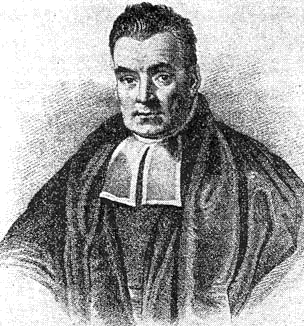
Reverend Thomas Bayes: evil clown fighter.
Fortunately, we have a tool, Bayes’ Theorem (named after the Reverend Thomas Bayes, who left this intellectual gem behind after his death in 1761), to integrate our intuition and systematic inquiry in a logically powerful way. Read more...
Kenneth Anderson wrote a provocative post at the Volokh Conspiracy entitled "Limits on Job Market for Scientists and STEM (and Why, in an Alternative Universe Not Consisting of Our Universities, You Should Also Study Humanities)."
This is my contribution to the discussion:
I majored in mechanical engineering, but I spent considerable time in elective courses on philosophy of science and American literature. I believe the combination gave me a rounder view of the world, taught me multiple disciplines of critical analysis, and prepared me to communicate effectively. I also think those integrated, cross disciplinary skills made me broadly employable as I've enjoyed being a teacher, an engineer, a marketeer, a strategist, and a consultant - most of the time in a lucrative manner (well, except the teaching, but I loved being a teacher, even as my waistline got thinner). However, I do think the engineering degree conferred an edge to my employability that a humanities degree alone would not have.
Looking back even further than engineering school, I'd have to say that it was my peculiar constitution, not the probability of employment, that lead me there. I never conceived of being anything but an engineer, and I'm not sure I would be happy pursuing anything else but engineering of some kind.
Today I have two high school boys, both of whom are bright, studious, disciplined, and creative, yet neither of them has a technical bone in their body. Their heads and hearts are firmly oriented to the humanities. While I cringe at the prospect of supporting them financially until they are 40, I also struggle with directing them toward a STEM related field knowing that without a passion or aptitude for it, they likely will not do their best, most creative, valuable work. So many of my colleagues vocally express hatred for their jobs because they were directed there through the employability argument. Their discontent expresses itself beyond words. While the rate of employment and initial salaries in STEM fields may be higher than in the humanities, putting aside the usual cynicism about success, a real interest in a field confers a comparative advantage that ultimately distinguishes career leaders from job seekers.
So now I encourage my boys not only to find their passion, but also to find a problem or unmet need in that field and develop a niche business around that. In other words, by developing an entrepreneurial mindset along with their chosen field of study, they hopefully will find a strategic improvement over the prior probability of finding employment with a humanities degree. My next door neighbor exemplifies these combined attributes. With dual undergraduate degrees in professional writing and Russian and a MBA, she now runs a very successful business writing & PR company. I know of several other examples similar to hers in which, finding themselves at odds with the reigning view of unemployability, they created their own employment, not just for themselves, but many others.
Entrepreneurship seems to be the missing ingredient in practically all the education and career guidance I see. I'm not sure that we necessarily ought to steer young people toward the fields that are currently the most commercially viable, simply because the demand might not sustain across the time horizon required to prepare for it, not everyone's interests and aptitudes will align with it, and being a job seeker is usually not (by my way of thinking, admittedly) the most fulfilling and productive way to live one's life or contribute significantly to culture. Right now I am convinced that learning to be an entrepreneur in whatever field of interest one has provides the greatest opportunity to overcome those prior limitations. Both STEM and humanities oriented education seem woefully absent of this guidance.
You would be shocked to learn how fast you can make it to the bottom of a lake with a cinder block tied to your leg. I know this rate, by my own empirical investigation, to be thirty feet per second, give or take. If you’re in the mind to disconfirm this experimentally determined value, I will tell you how to repeat this experiment for yourself. First, convince yourself there are freshwater pearls in the mussels that live in your grandfather’s lake…
This is an example of the fresh water pearl mussel. I never found any. If you aren't careful, you might, too.
When the words came tumbling out of my mouth, I felt it all goin’ south, But I kept on talkin’ ‘Til you started walking. Now I’m trying to dig my way out. Ain’t I got a right to be wrong?
I was a whiz kid in college. You know, the kind of kid my professors wanted to whiz on. The reason: I was quick to argue, often too quick. College presented a very competitive environment to me. Rather than learn from others who actually knew better and had something to teach me, I often let myself get caught in the trap of thinking that competitive posturing would advance my career. I know now that never happens in the business environment among mature adults, but in the mind of a sophomore engineering student surrounded by thousands of people all competing for grades and corporate placement, winning seemed like a fine goal to have in mind. #winning
Peace. Love. War. Sex. Money. Life. Death. These are some of the most important issues we all deal with in more reflective and philosophical moments.
Oh yeah, and a good shave. Let me explain: I know the answer to this one now.
This is going to be a bit of a departure from my normal posts. It's a little more personal, related to concerns of daily life, and my recent experience with what I think is going to be a great product. But before I get there, let me tell you a little of the background about why I'm writing this.
For years I've pursued a good shave. My combination of medium beard (while it doesn't grow exceptionally fast, it's evenly distributed with follicles of moderate thickness) and skin sensitivity have made this routine the source of quite a bit of frustration since puberty. As the initiated know, the best shave comes from a barber using a straight razor. But who can afford doing that every day or so? And for the DIY-inclinced, have you seen the price of good straight razors? Even DIYers have to admit that the price of a good straight razor just isn't justifiable. So, I've tried electric razors of all kinds. Double blades. triple blades. The latest high tech Gillette 10-blades. You name it. In fact, one time I tried to use a depilatory cream instead of shaving altogether. What I got was a chemical burn on my neck that is still observable 20 years later. I've also tried every kind of shaving cream and aftershave balms you can imagine. All I want is a good shave at an affordable price that doesn't leave my face irritated. (You may be wondering why I don't just go with a beard. I've done that, too, but in addition to being especially abrasive to my wife and always worrying about whether I have food lodged in it, I look a bit like a leprechaun due to my Scot Irish heritage.)
This is where I've settled. I shave in a hot shower using the Schick Xtreme3 with the aloe strip, and I use Dial soap as a shave cream. I'm serious. Dial soap! I wipe the bar of Dial over my face, lather it up with my hands, and chop away. And it works pretty well. Whatever the chemical reaction is of the aloe strip and the glycerin (possibly?) in the Dial soap, it produces the absolute slickest surfactant I've ever seen. Unfortunately, the experience isn't altogether consistent in quality because sometimes the blades come a little dull or the aloe strip isn't imbued with the right amount of aloe.
Then a friend sent me a link a few weeks ago to the newly launched Dollar Shave Club. Their snarky video was enough to make me watch it three or four times. But I was intrigued because here they were claiming "Our Blades Are F***ing Great," and I did not have a particularly good shave that morning. I was in the mood to change - I admit it. After doing a little cost tradeoff analysis, I decided to try The 4X for $6 per month (and no S&H!). I signed up, and began anticipating blades that were f***ing great.
And then depression set in. A week later, I received an email informing me that "the internet arrived" at DSC and they were swamped with so many new orders that they had simply run out of inventory. My shipment would be delayed until May 15, about a month later.
So I waited. And I watched the snarky video again. Well, actually I watched it several more times, as I imagined what it was going to be like using blades that were f***ing great.
The blades finally arrived in the mail on May 21st. The package of four four-bladed razors (with an aloe strip) came with a weighty handle made of metallocene plastic. Enclosed was a little card informing me that I was now a "member of an elite group of stratospheric thinkers" and that I was entitled to a free drink at any bar in the US where I presented the card. (More snarkiness in the follow up - with the appropriate disclaimer, of course. You will still be in the elite group of stratospheric thinkers.) On the morning of May 22nd, I used a DSC razor according to my routine manner for the first time.
The shave was f***ing great.
(I'm saying that in a hushed whisper now, as I observe a moment of reverent silence.)
The blades were smooth and sharp. The blade head was wide and hugged my face securely as the pivot worked exactly as designed. The aloe strip didn't quite deliver the same surfactant quality as the Schick, but it was good.
I’m also going to save $24/year. Admittedly, that’s not a lot, but I can apply it to my Starbucks addiction. Every little bit counts.
But OMG! The shave was the smoothest I've ever had. Two mornings later, the same blade cartridge delivered the same quality of shave as it did on the first day.
Do I sound like a giddy school girl after her first kiss? I won't shy away from that description, but it may go beyond even that because not two hours after my first shave with a DSC razor, I was thinking, as I drove to a client meeting, I'd like to go back and have another shave. All I wanted was just one more shave. Just one. I could turn around, go back home, and claim that Atlanta traffic was doing its normal thing to excuse my tardiness.
Now, I do have some critical recommendations for DSC (DSC, are you listening?). First, get that supply chain fixed, if you haven't already. You can't let another surprise catch you off guard like it did on your opening day or let customers feel that letdown again of being told that the most amazing razor in the world will be late. Second, figure out what Schick is putting in their aloe strip. I don't care how you find out, who you have to bribe, how you reverse engineer it, or what levels of corporate espionage you have to engage in, get that strip! Your razors will go from being f***ing great to holy mother of cheese and crackers f***ing great.
So, on a scale of 1 to 5, I'm giving DSC a 4. I think eventually they will reach a 5, but the initial delay really was a letdown. I had to discount them –1 to maintain my sense of fairness and objectivity.
If after reading this you are inclined to join an elite group of stratospheric thinkers, click this link and go from there. Honestly, with each signup that occurs through this link, I get a free shipment of blades. But I'm not asking you to be completely altruistic. If you sign up, you can get free blades, too, through your own referral link. See, we all win.
"Intelligence Is Overrated: What You Really Need To Succeed"
That was the headline from a Forbes editorial. But do you really agree with it?
The problem for me is that the article doesn't define success comprehensively and from whose perspective, except to say, "...executive competence and corporate success. Research carried out by the Carnegie Institute of Technology shows that 85 percent of your financial success (emphasis added)." In other words, the amount of money you make in life is the criteria it deals with, although the title might leave the discussion open for a broader perspective about success. Even if monetary success is the goal, the desired level of monetary income and accrual might vary greatly from one person to another. When I read about success, I really want a more rounded consideration.
How should we think about success: success as society views success, as an individual views success, or some hybrid? Do the criteria in the Forbes article apply across the board for all types of success or just executive competence and corporate success?
The qualities required to satisfy "success" from one perspective may be different from those of another perspective. I'm not so sure the four criteria (IQ, EQ, MQ, BQ) in the Forbes article are equally relevant as predictors across the different perspectives of success.
In their given fields of endeavor, I would say Jobs, Erdős, and Boyd were all successful, but none of them mastered all four criteria described in the article. Jobs, Erdős, and Boyd were frequently described as lacking emotional intelligence. Some might argue that Jobs lacked both emotional and moral intelligence. Erdős was notorious for his (ab)use of amphetamines and caffeine and limited sleep, showing little regard for his BQ. But they each sought a different kind of success premised in the Forbes article. Personally, I think the characteristics consistent with them were high IQ and dogged, relentless, obsessive pursuit of their goal. I especially don't think the article addressed the latter.
Furthermore, the article didn't really address the idea that there are different levels of success and different strategies to get there related to risk preference and the means of managing it. I think the article most likely addresses the kind of success associated with managing the probability of success/failure to achieve desirably moderate returns versus pursuing higher potential value with a low probability of success.
Of course I'm speculating, but I'd wager that people who master all four criteria in the article usually achieve moderate levels of personal and financial success, and the failure rate among them is low. These are people who finish high school, get a college degree (or more), and become day-to-day leaders and executives. But they aren't the kind of people who typically change the world in far reaching ways. They do keep the world running, and that's important. It is one measure of success.
On the other hand, people who pursue the potential value side of the equation tend to be extreme risk takers. Unfortunately, they may frequently fail to understand when they are wrong, so the rate of failure among them is high. They make up for their lack of mastering the latter three criteria with unrelenting obsession, though. So while many of these people might often head down a dead end pathway, when they do get it right, you see world changing kinds of success. They may profit from it with money and fame, or they may not. In some cases, they may not even know about the extent of their contribution (think Nikola Tesla). The success with this crowd is self-selecting, as you rarely hear about the people who pursue the same strategy and fail to achieve their goals.
As Jobs being the most prominent example, significant commercial areas were affected by his success. Even if you don't use an Apple product, you benefit from the design esthetic he developed, or the advancements he led in other commercial areas, or the resultant competition his success drove. Maybe you wouldn't want his success for yourself, and there's nothing wrong with that. Jobs, on the other, wanted it at the expense of the ideals you might hold dear. The same could be said for Erdos and Boyd. My thinking here, on a late Sunday night, is that success first needs to be clearly defined for yourself, and the tradeoffs required to get there need to be thoughtfully considered over and over. But success by our standards shouldn't necessarily preclude our recognition of success by other standards.
From as early as I can remember, I have always wanted to be a scientist. Indeed, while most kids my age were doing normal, healthy kid things on summer afternoons, like engaging in war games or playing with anatomically disproportionate Barbie dolls, I was usually in my secret lab (which was actually a sewing table my father converted to a “lab bench”) looking through my Bendai microscope or mixing chemicals with my Science Fair Chemcraft chemistry set. I distinctly remember on the playground one day, after being bowled over in a dodge ball game, one of my grade school classmates asking me, “You don’t really like sports, do you?” I responded through bloodied lips, “I like to think of science as my sport.” Of course, that admission advanced my standing in the picking order for the next game, as the best were always saved for last.
A controversy about experiments in extra-sensory perception throws some light, and maybe some confusion, on the idea of statistical significance. This article discusses a common misinterpretation of the results of significance tests, and investigates some criticisms of significance tests in general.
I'm a crappy friend, and here's why. When asked a question that a friend of mine deemed important, I turned his questions back to him in the form of additional questions. Maybe I'm uncomfortable with familiar certitude, or else I'm just content to be a gad fly.
Maybe I'm too much of a coward to give a straight answer. You can judge for yourself after you read the rest of this post. (You will, won't you?)
To set the context, here's the note (posted with permission).
"Hi Rob,
So, I read this [link from Wikipedia to my daughter] yesterday and asked if she believed it:
Joseph Smith Jr. said that when he was seventeen years of age an angel of God, named Moroni, appeared to him,[10] and said that a collection of ancient writings, engraved on golden plates by ancient prophets, was buried in a nearby hill in Wayne County, New York. The writings described a people whom God had led from Jerusalem to the Western Hemisphere 600 years before Jesus' birth. According to the narrative, Moroni was the last prophet among these people and had buried the record, which God had promised to bring forth in the latter days. Smith stated that he was instructed by Moroni to meet at the hill annually each September 22 to receive further instructions and that four years after the initial visit, in 1827, he was allowed to take the plates and was directed to translate them into English. http://en.wikipedia.org/wiki/Book_of_Mormon
She said 'no,' so I asked her why she believed a man lived in the belly of a fish for three days and the story of an ark and a talking donkey, etc., but she didn't believe this story. She thought for a second and said, 'because you didn't teach that to me' (which is a more honest answer than when I ask her why her room isn't clean). So I asked her if we were sharing the story of Jesus with a non-believer or even someone in a country that was not familiar with the Bible what would make them believe one set of stories and not the other. She didn't have an answer and I'm not sure I do either.
This has always been one of my sticking points (noted in the article):
For some followers of the Latter Day Saint movement, unresolved issues of the book's historical authenticity and the lack of conclusive archaeological evidence have led them to adopt a compromise position that the Book of Mormon may be the creation of Smith, but that it was nevertheless created through divine inspiration.[36] The position of most members of the Latter Day Saint movement and the official position of The Church of Jesus Christ of Latter-day Saints (LDS Church) is that the book is an actual and accurate historical record.
Thus, I'm asking if you have any thoughts on this."
No one is really questioning the Mormon church here. My friend's question is related to his own unresolved issues, not those of you who wear the special undergarments.
My crappy response? Here it is...
"First of all, I think you need to realize that you’re asking your daughter to do something very dangerous. In the end, she may not believe what you believe. Can you handle that, knowing that you started her on that road of inquiry and questioning?
Second, what do you hope to achieve by asking your daughter to take on this line of questioning? Do you want her to have a more secure rationale of the stories she believes in by faith in you (which she more or less admitted to, and with honesty, as you point out)? Or do you want your daughter to learn to live life on more courageous and rational terms; i.e., not driven by others’ forcible dictates or emotional manipulations against her own interests, or not driven by her own casual acceptance of poor thinking (which, in our own way, we all suffer from)?
Finally, I’m not going to answer your question directly. I’m going to turn the questions back on you. How do you establish that any belief is worthy of protracted attention and possibly worthy of bringing others to a similar level of attention? It seems to me that before you give your daughter some guidance in this regard, you ought to have given some measure of consideration to the following.
What are the criteria that you use to judge the veracity of a claim?
How do you determine that a belief should be significant to you?
How do you determine that a belief should be significant to others?
How do you determine that you have an obligation to communicate to others about it?
How do you determine that your beliefs are worthy enough to impose some obligation on others?
I hope you can live with some ambiguity on a Wednesday afternoon. :)
Best regards,
Rob"
I don't think I exactly gave a straight, supportive answer.
The romantic ideal I possess of a stalwart friend is one who would give reassuring answers. Clear answers. None of that ambiguous, oblique stuff that makes you lie awake at night staring at the ceiling. Like I said, I'm a crappy friend.
So while I might want to be a good friend and fall short, above all I want to be an honest friend when it matters. (Yeah, I qualify that. I'll leave it up to you to ponder when a little dishonesty might be helpful.) Looking back on it, I have to say that one of the most important lessons I gained from engineering school was to realize I have the moral authority to ask: "How do you know that?"
And so I ask, dear reader, how do YOU know that?
In the context of this thread, I don't care if you believe in Joseph Smith and the story of Maroni. For that matter, I don't care if you believe in Scientology, Buddha, Jesus, or Mohammed. Global warming or not, evolution or special creation, secret societies that malevolently run the planet or that government is just always inept. I don't care.
I don't care if you believe in a gold standard, a bimetallic standard, or a fiat currency.
I don't care if you believe that you should never get involved in a land war in Asia or that you should never go in against a Sicilian when death in on the line.
I. Don't. Care.
What I do care about is this: If we believe that our beliefs are worthy enough to affect others, I want to know - how do we know that? Let's start right there.
At the tender age of 17 I sold my soul to a 1979 MG Midget. Or, at least I sold my body into indentured servitude to it. I spent my entire earnings from two prior summer jobs and my part time job after school to acquire this little gem. Fire engine red. Black racing stripes. Mag wheels. And, yes, a sixty-five BHP engine. As cool as that sounds and as anyone who has ever owned a British Leyland product already knows, I spent a lot of time tinkering with the car to keep it running, often at the most inconvenient of times.
One of the great benefits of empowered social networking these days is the opportunity to meet (virtually, of course) fantastic people. While Facebook has been great for keeping up with friends from high school, college, and more non-vocational social circles, and Twitter has been fun for following the latest snarky comments from people I never meet but might like to, LinkedIn has been great for actually expanding the circle of people I meet with more vocational interests. Recently, Mary Ritenour and I met in a discussion forum as we both detected that someone on the interwebs was wrong (I tell you, they were totally wrong!). A sort of emergent tag team arose between us in which we attempted to help bring a few entrenched mindsets to, at least, the realization of the existence of an alternate viewpoint. No one yelled, "Uncle!" in the end, but the exchange proved largely exciting and challenging while maintaing a sense of reasoned decorum and respect. On the internet! I know! I'm speechless, too.
In our sidebar conversation, Mary and I got into a discussion about reasoning, persistence of belief systems in the face of disconfirming evidence, and bias - not just of others, but our own. It was through the thread of this conversation that Mary told me about an exchange she had with a friend who confided that she was having difficulty making sense of the claims from experts in important complex issues. Mary's friend's complaint went something like this: "This underscores my frustration with science/technology and politics. As a non-scientist, I can and do follow the debate, but how can I understand the problem when both sides produce different sets of facts and thus generate conflicting theories and computer generated futures?" Obviously there seems to be a true desire here to understand and yet a frustration and lack of tools to sort through "competing facts."
Mary then suggested the following to me, which I thought was pretty good. "It occurred to me that perhaps the greatest need is...demonstrations of HOW to think through issues, without advocating a position." I think she's on to something here. "If we truly practice what we preach (of freedom of thought, of individual’s right to self determination) then we should demonstrate HOW to think, rather than just provide more facts. It changes the game. It provides respect to the searchers, and tools for them to use in their search for the truth. If the logic and truth of our beliefs are not discoverable by those means then what hope is there?"
The following are what Mary eventually suggested to her friend. I loved its crunchy goodness so much I wanted to share it with you. While you read it, I'm going to refill my coffee. I'll be right back.
Mary Ritenour's "Figuring Out the Truth" Ten Rules of Thumb:
Work to strip out the emotional reactions; try to be as factual and data driven as possible. Go to original sources for data whenever possible.
Expect complexity. Don’t settle for simplistic solutions or claims. Life and life’s issues are, for the most part, not one-dimensional. That does not mean that you should avoid decisions, but recognize that nearly all of life’s choices come with not insignificant trade-offs.
Credible experts are the ones that are transparent about their information, acknowledge when their opinions change, willingly share their thinking processes, and invite debate as a way to improve EVERYONE’s understanding of an issue.
Never let anyone tell you what to think or how to feel about an issue. You have the right to form your own opinion, to do your own fact gathering, consult your own experts (and hold those experts to your "Rules of Thumb" standards!).
You have the right to change your opinion as you become aware of additional information. Indeed, learning and developing more depth of understanding is part of my definition of maturity.
The behavior of those advocating a position can tell you something about their own commitment/belief in what they are advocating. Someone who tells me that fast food is toxic, but eats at McDonald’s every day has no credibility with me.
Be wary of "emergency" or "crisis" claims." The sky is rarely truly falling, and those who insist on immediate action usually want you to act before thinking for a reason. ("Experts" have been predicting awful calamities since the first hominid saw the first meteor – the accuracy rate of these predictions nears zero.) Reserve the right to take your time to think through your options.
Learn enough about statistics, logic (especially fallacies of reasoning), basic research, and risk analysis to be BS inoculated. This includes learning to ask questions like "How did you arrive at that conclusion?" "Where did you get your data?" "What assumptions did you use in gathering/analyzing that data?" "What is your ultimate objective/goal?" "How do you know that?"
People act in ways that they perceive are in their best interest. That "best interest" includes being socially acceptable in their circle of friends, feeling as though they are part of some larger good (recycling, etc) or simply the pleasure of "doing good." To more clearly understand someone's choices, you need to understand the options they had to choose from (or that they thought they had to choose from) – the context of their decision is important to understand. Without understanding that context, their decisions may not make any sense to you. Your reaction to them may appear hostile, which just impedes the process toward understanding each other.
Those who insist you be either "for" or "against" their position are not advocating a position on an issue so much as asserting a dogma. If they don’t have enough respect for you to hear your opinions and questions, or searching for some alternate "none of the above" solution, it speaks poorly of their own reasoning skills and quality of their proposed solutions.
Pretty good, huh? I knew you would enjoy it. Now, let's go live it.
In the meantime, there are two books within this vein that I would like to recommend to you. Go check them out.
I've been concerned lately about the state of business intelligence (BI) systems I've seen implemented in the wilds of business.
Currently, BI systems are essentially accounting and reporting systems, oftentimes accompanied with very sophisticated data visualization. That is, they show current and past states of collected information. From this information, trends, correlations, and anomalies can be determined and observed, but they don’t say what they mean to stakeholders. Do the trends and anomalies imply that something important is happening and should have some attention applied to them, or are they simply passing stochastic fluctuations? If they do need attention, what should the action be:
Correction/mitigation - to bring the system back into control or avoid undesirable outcomes
Exploitation - to take advantage of new opportunities to gain competitive advantage?
How do you decide?
Furthermore, there is, I suspect, another risk that lurks within the use of BI systems related to cognitive biases. There is quite a bit of research that shows that there is an optimum to the amount of information executives need to make well-formed decisions. If there is too little, executives are exposed to unfortunate surprises due to lack of critical information. Action based on recent or colorful available information is called, unsurprisingly, recency and availability bias. It’s easy to help people see why this bias is so pernicious. Just remind them of events they didn’t anticipate, or show them how being too careful in consideration of extreme events or too prejudicial in consideration of emotionally vivid information is likely costing them too much money. The other extreme is having too much information, and it’s difficult to convince people why this is a problem. Here the executive has so much information that they place higher and higher confidence on the validity of their reasoning, while the research shows that their performance doesn’t improve in a commensurate way. It’s often difficult to explain why this is the case because people typically don’t tie the success or failure to their initiatives to the level of information they were using when they made their decisions, and the time lag between when decision are made and when results are measured often extends beyond the memory of participants as well as the presence of the participants. This latter cognitive failure is related to overconfidence bias. (For a longer list of cognitive biases, go here.)
The effects of the interactions of BI systems within the presence of the various cognitive biases is
A failure to create a shared understanding of how goals and objectives work together to create value, leading to frustrated ambiguity about the real reasons for taking corrective or exploitative action
Only the "tangible" costs and benefits are estimated, leaving the fuller range of "intangible" costs and benefits unquantified, treated only in qualitative manner, or disregarded altogether
The full range of business uncertainty and risk is often overlooked or not understood, leading first to endless discussions about assumptions and forecasts, and finally to unanticipated outcomes and continual rework or unrealized value
Decision prioritization is based on politics rather than a quantified value to the business
Trade-offs between decision timing, optionality, and value are ignored
So, when you do decide take some corrective or exploitative action, how do you know that the actions you take are the most valuable ones and not simply satisficing decisions or, worse, inconsistent and incoherent?
What is missing is an intelligent decision management system that guides decision makers consistently through the thorny issues of what to do in the presence of trends and anomalies reported by their BI systems. An intelligent decision management system will do at least four things reporting systems coupled with unguided thinking cannot do:
Synthesize seemingly unrelated information
Abstract information into requisite models that includes the characterizations of appropriate uncertainties controlled for bias
Compare/contrast possible strategies to address trends and anomalies against the stakeholders’ subjective preferences
Interpret results of the analysis into competitive responses
It does not throw out the BI systems. It complements them. It provides an executive monitoring and feedback loop into the current state and trajectory of an enterprise.
I'm just thinking "out loud" here...about thinking.
Intelligence is a kind of measurement of the quality of problem solving.
Agents are systems that have at least one preferred state. A simple agent possesses one to many preferred states, but they aren’t connected. Complicated agents have at least two preferred states, and the achievement of one increases the likelihood of achieving the other. In fact, one state cannot be achieved unless a predecessor state is achieved. The preferred states are hierarchical in nature. A complex agent is one in which its preferred states are interdependent upon each other, and they operate as a network of self-supporting preferences. These are complex systems in which one of the preferred states feeds back into another.
When an agent is perturbed from its preferred stated or its preferred state changes relative to the one currently occupied, a problem occurs that must be solved. A problem is a deviation from a preferred state. Problem complexity is determined by the number and timing of the coordinated activities that are required to solve the problem; i.e., restore the agent to its desired state. Therefore, an agent is a system with a preferred state(s) that solves problems.
Intelligence is the measure of the ability of an agent to solve problems relative to that of other agents. It has five(?) dimensions to it: speed, cost, soluble limit, elegance, and abstraction.
Speed: For two agents facing the same novel problem of a given complexity, the agent with the greater intelligence solves the problem faster than the other agent. In this case, intelligence is a function of "clock speed." More intelligent agents find ways to operate faster.
Cost: For two agents facing the same novel problem of a given complexity, the agent with the greater intelligence solves the problem with fewer tokens of cost.
Soluble limits: For two agents solving novel problems in the same amount of time, the agent with the greater intelligence solves the more complex problem.
Elegance: For two agents facing the same novel problem of a given complexity, the agent with the greater intelligence solves the problem with fewer computational or execution steps. This is a measure of insight. The agent sees through the clutter and noise of the problem to the simplest of solutions. The net result might be faster computation, but not because step-wise operations are performed faster (e.g. due to higher clock speed), but because fewer operations are performed at a given clock speed.
Abstraction: For two agents facing a similar problem again, the agent with the greater intelligence solves the problem faster than the other agent. This may sound like a repetition of the first measure, but it really is a measure of the memory system that permits recall and comparison. Less intelligent agents face more novel problems (from its own perspective) over an equivalent life span than more intelligent agents. The more intelligent agent observes similarities across problems and reuses prior solutions. Given this, the intelligence of an agent at time t can be compared to its own intelligence at t-k. A learning agent, then, is one that improves its intelligence over time because it can recall and abstract problem characteristics to other problems.
(Are there others?)
We shouldn’t think of intelligence as something that necessarily occurs in nervous systems. Intelligence is the quality of any goal seeking system to achieve it’s preferred goals, usually in comparison to similar agents. Thus, a gazelle that is capable of escaping a stalking lion more quickly than an aardvark is more intelligent regardless of the cognitive effort employed. The intelligence may result in the ability to run faster than aardvarks. The intelligence is not a measure of a specific gazelle’s capabilities, but that of the gazelle system that produces gazelles versus the aardvark system that produces aardvarks. Of course, aardvark systems have produced solutions to the problem of stalking lions that gazelle systems have not found.
Here are a few questions I have about human intelligence.
Is there a limit to the kinds of problems humans can solve?
Is there a limit to the kinds of problems any agent can solve?
People commonly referred to as “idiot savants” are those who seem to be able to solve fantastically difficult problems with little effort, but the type of problem solving is of a particularly isolated kind. Would it be possible to isolate the characteristics of cognitive development that allow for this concentrated effort? Then would it be possible to extend that development to a wider range of problem kinds?
The history of the world’s intelligences seems to be characterized by systems of evolutionary genetic organic chemical systems. Gene systems solve environmental problems of survivability for gene populations. Humans seem to represent a peak of genetic problem solving capabilities in the form of complex nervous systems that have the ability now to ask questions about their own capabilities to solve problems. Sophisticated nervous systems solve problems much more efficiently than genetic systems alone. Has the problem solving ability of nervous systems, itself the product of genetic systems, now found the layer of problem solving for a gene population that doesn’t require genetic rules to continue to find solutions to its environmental problems of survivability? In other words, is it possible that human intelligence is now circumventing it’s own genetic evolution, even to the point that genetic evolution will be unnecessary?
What if one problem brought on by self awareness (a genetic solution to another survivability problem) is the awareness of death. The preference for self aware systems might be to avoid death. Would it be possible for self aware systems to solve the problem of terminating self awareness (death) by engineering a mechanism by which awareness exists beyond the current genetically determined neural solution?
We hold these truths to be self-evident, that all men are created equal, that they are endowed by their Creator with certain unalienable rights, that among these are life, liberty and the pursuit of happiness. That to secure these rights, governments are instituted among men, deriving their just powers from the consent of the governed.
Three days ago I reaffirmed my belief in the historically radical idea that people have an innate, unalienable right to life, liberty, and the pursuit of happiness. I ate some barbecue and ignited some small scale incendiary devices with good friends to commemorate this ideal. These banal means of celebration are actually more profound than I think we usually give thought to. They represent the culmination of society's progress. I mean that. Stay with me here.
If we are going to put an end to a person's life, we had better have airtight knowledge that the person committed an act of such unconscionable magnitude that society itself cannot tolerate that person's continued existence; i.e., that society's effective operation and possible existence is jeopardized by that person's continued existence. That's a tall criteria to satisfy.
Particularly, what I'm driving at is this: the death of Caylee Anthony is a tragedy. There is no doubt in my mind that the person responsible for her death or responsible for her wellbeing at the time of her death has evaded justice. That is a hard pill to swallow for a society that loves justice. But if we as a society, via the jury in this case, had convicted her mother, Casey Anthony, and sentenced her to death while a plausible doubt existed about her actual guilt, much less her actual involvement in the death, we would double the harm done to our society in this affair. That would be irrational, which means that it would be arbitrary. And if arbitrariness rules the day, then society actually poses a threat to itself. This is not just high minded idealism. It literally means no more barbecue in the comfort of sedate neighborhoods and shady cul-de-sacs. Really. The barbarians would gather their hordes again. I don't know how long it would take, but it would eventually happen. The arc of cultural progress over the last 2,500 years has converged on bringing at bay the irrational judgements of the hordes and the superstitious with judicial progress, a situation I suspect that we have mostly forgotten. Would we now jeopardize that progress to satisfy a need for emotional closure, even a justifiable one? Of course, it's more than barbecue and fireworks. Those are just symbols for something more important. They are a type of communion that commemorates a greater ideal. Not only would we now find ourselves threatening the life of another person, we would be threatening the lives of all of us, dishonoring the unalienable rights we hold dear.
Life is full of ambiguous situations, and we often make decisions facing a great deal of uncertainty and ambiguity. We usually try to do the best we can given the information we possess at the moment of decision, and then we make corrections along the way. We even anticipate that corrections will be needed because we know that life is subject to ever evolving influences. In some cases, though, decisions produce totally irreversible consequences* - such as executing a person convicted of a crime. Yet we want and need justice to be served? How do we proceed?
Suppose you face making a decision that impacts someone else directly. Ask yourself: would you be willing to submit to the same information conditions and outcomes the recipient of your decision faces? Now, suppose you had a gun that could deliver that outcome to you. The gun is omniscient. It knows the absolute truth of the case in question. In the moment of decision, you pull the trigger. If your judgment is coherent with the knowledge of the gun, you walk away unharmed. But if you are wrong, the gun delivers the same consequence that you would dish out. If you believe your judgement is certainly correct, then pulling the trigger is no problem. But if there is any doubt in your mind that you are correct in your judgment, and, more importantly, that you cannot tolerate the outcome, you might delay pulling the trigger or just defer altogether. When doubt exists, when the stakes are irreversible, deferring our sense of satisfying justice may deliver a higher degree of actual justice.
I don't know whether Casey Anthony killed her daughter or not. While I may harbor suspicions, that's all I have. My suspicions have been wrong in the past, and sometimes with embarrassing consequences. Fortunately for me, the stakes associated with my judgements based on poorly formed suspicions have usually been relegated to some loss of face, property, or relationships. In this case, a jury held the LIFE of another person in their consideration. Given the emotional content of the case and the ambiguous evidence brought to trial, as best as I can tell, the jury behaved in a circumspect manner that is commensurate with a society that values reason and maximizing justice. The jury behaved in a manner that recognized that pulling the trigger on the truth gun possibly led to an intolerable outcome - another (potentially) innocent person losing her life.
Unserved justice is a hard pill to swallow. But mis-served justice is a bigger travesty. A rational justice system operates on this idea.
*Actually, all decisions involve irreversibility because all actual decisions occur in time. While a perturbed bearing or position might be eventually restored, the time required to regain it cannot be.
Inc. Online published an article on Feb 24, 2011 entitled "Tactics Are the New Strategy" and opened the article with the following: "Strategic management can be a huge time drain for managers. Why not just ditch the conventional wisdom and go with your intuition in order to innovate once in a while?"
It sounds fun and certainly less constraining than the pathology the article describes, but we take some issue with some key points in the article.
Unfortunately, many managers who "devote an excessive amount of time developing, researching, and validating their strategy" may have fallen victim to a pathology commonly referred to as "analysis paralysis". This pattern of behavior seems to be based on a belief that every detail of execution can be planned beforehand, forecast precisely and executed without hindrance. This micromanagement approach may be called strategic planning, but it fails to be effective as real strategic thinking. Companies that commit themselves to this approach frequently destroy value by missing opportunity windows or simply wearing out people's patience.
However, the other end of the spectrum from "analysis paralysis" is really just a series of ad hoc tactics that make sense in the moment. Without strategic alignment, these actions can whipsaw an organization into a kind of swirling motion that results in no real progress. Wins, when they occur, may be more a product of luck than strategic design and are rarely sustainable. Companies that follow this approach to management often destroy value because they don't anticipate important events that require mitigation or off-ramps from their current course of action. And probably worse, they don't have the framework to construct the type of creative hybrid strategy that develops from alignment of the combined wisdom and various internal viewpoints. The players with these viewpoints may remain adversarial to each other or even in open conflict if they are independently carrying out their own ad hoc tactical approaches.
A third approach that provides managers amazing flexibility is outlined in our presentation titled "Quantifying - Not Assuming - Making Sense of Intangibles, Uncertainties and Risks." Our approach leads to effective strategy alignment and decisions in days and weeks compared to the months or years of the "analysis paralysis" type of strategic planning. It also avoids the ad hoc tactical approach of "flying by the seat of your pants" with its related risks. The net effect is that our approach actually accelerates value creation because managers quickly find a strategic theme to align informed and efficient tactical execution while avoiding the rework that inevitably arises from a "ready, fire, aim" approach that lacks clear strategic alignment.
The Foundation for Economic Freedom (FEE) has been linked on this blog for several years now. It provides a great set of resources for students of economic thought and liberty.
I just found out today that FEE has opened an office in Atlanta, GA, and that President Lawrence Reed will be hosting a talk in my hometown of Newnan, GA on February 15. You can obtain more details here.
McKinsey offers some useful tests to determine the quality of a corporate strategy. But do you know HOW to create a strategy that passes the tests?
Here are four of the ten tests. They aren't necessarily the most important, but the issues they address crop up in EVERY client I serve. My suspicion, then, is that those same issues crop up in every organization.
Test 5: Does your strategy rest on privileged insights?
Test 6: Does your strategy embrace uncertainty?
Test 7: Does your strategy balance commitment and flexibility?
Test 8: Is your strategy contaminated by bias?
So, I ask...
How do you gain insights where others don't?
How do you handle uncertainty in the decision making process of strategic planning?
Do you quantify the effects of uncertainty? Do you know how to?
Do you know how much uncertainty leads to potential risk?
How do you make tradeoffs in the decision to gather better information and the cost to do so?
How do you make tradeoffs in the decision to gain more control over uncertain events and the cost to do so?
Do you attempt to optimize strategies (exposing them to fragility) or make them robust to a wide range of events?
How do you control for the effects of bias and avoid committing to favorite strategies versus better ones?
Georgia's new "No Texting While Driving" law went into effect on Friday, July 2, 2010. I know of no one who questions that texting while driving - indeed doing anything that distracts a driver - is smart behavior. However, mobile phones with multiple functions represent a deeply embedded part of our culture now, supplying quick communication and information in situations where we find ourselves untethered to our computers.
But every policy, law, and action produce unintended consequences. What unintended consequences might you conceive this new law will create? As you think about that question, read the results of these two new studies here and here. I've got your unintended consequence right here:
Drivers may now be texting in ways so as not to get caught doing so, such as lowering their phones and thus drawing their eyes down away from the road.
I don't pose this question to debate the merits of the new law. Rather, I thought it might be a good way to help us think about how, in our businesses, we often initiate policies with good intentions only to find that something unanticipated, desirable or undesirable, emerges as a consequent. So...
What unintended consequences might you conceive this new law will create?
What policies have you initiated that produced unintended consequences?
How did you deal with those consequences?
What efforts do you employ now to limit the effects of undesirable unintended consequences?
If you have attended a motivational speech recently, you likely have heard this story:
There was an interesting experiment that started with five monkeys in a cage. A banana hung inside the cage with a set of steps placed underneath it. After a while, a monkey went to the steps and started to climb towards the banana, but when he touched the steps, he set off a spray that soaked all the other monkeys with cold water. Another monkey tried to reach the banana with the same result. It didn't take long for the monkeys to learn that the best way to stay dry was to prevent any monkey from attempting to reach the banana.
The next stage of the experiment was to remove the spray from the cage and to replace one of the monkeys with a new one. Of course, the new monkey saw the banana and went over to climb the steps. To his horror, the other monkeys attacked him. After another attempt, he learnt that if he touched the steps, he would be assaulted.
Next, another of the original five was replaced with a new monkey. The newcomer went to the steps and was attacked. The previous newcomer joined in the attack with enthusiasm!
Then, a third monkey was replaced with a new one and then a fourth. Every time a newcomer approached the steps, he was attacked. Most of the monkeys beating him had no idea why they were not allowed to climb the steps or why they were joining in the beating of the newest monkey.
After replacing the fifth monkey, none of the monkeys had ever been sprayed with water. Still, no monkey ever approached the steps. Why not? Because as far as they knew it was the way it had always been done around here...and that is how company policy begins.
Or racism. Or religion. Or Aunt Gertrude using a certain sized pot to make roast.
(Not wanting to withhold a multimedia learning experience from you, you can watch the full length motion picture here, starring Ashton Kutcher and Keanu Reeves.)
I grew suspicious of that story, so I’ve been trying to corroborate it. Curiously, I cannot. I do find a multitude of retellings with variations, which makes me more suspicious. Some n-th degree sources suggest that the experiment may have some origin with the famous Harlow rhesus monkey experiments.
But that brings up another interesting point, at least about humans and their desire to construct just-so stories to explain vexing phenomena. Most versions of the story purport to explain how corporate policy gets made, by which we have all been unceremoniously doused. And we rage inside against it in our cubicles. Or we complain at the water cooler about the guys upstairs in their ivory towers who don't understand what we go through down here in the trenches, on the front, everyday, slaving away for this measly check. Ultimately, a funny story gets written about how monkeys are used in an authoritative sounding experiment to help explain how corporate policies or unreasonable social norms develop, possibly for long forgotten reasons, and get passed along to robotically observing generations. The explanation gives us a sense of order to the universe that helps us cope with the world we can't control. But of course, I haven't conducted an experiment yet to prove that proposition.
Ironic, isn’t it, that a story’s credibility that attempts to explain unquestioned adherence to cultural norms is unquestioned for years? The story is its own monkey story! How’s that for self-referencing?
Unfortunately, the “best explanation” is usually the most emotionally satisfying one. It could also be the most dangerous one, too. And the Five Monkeys Experiment is a beautiful example of how that can be, not for it's uncorroborated content, but for the way the story has a life of its own.
"Knowledge of the future automatically alters our actions. These, in turn, alter the future. Are attempts to predict the future futile?"
I would not strictly say so, but you have to modify what you mean by "predict".
Before the Modern Era, people believed that the state of the universe was determined by fate (pre-Enlightenment) or strict deterministic mechanics (Enlightenment). For the most part, they did not believe in a two-way dynamic entanglement between the state of the universe and human intention and action, nor did they strongly believe in random events. So when people spoke about making predictions, they believed that if a prophet did make a prediction about some future state, the prophet would be able to foretell the exact state, if the prophet possessed true clairvoyance or spoke with authority from God. Colloquially, people still have that idea in mind when they think about the term prediction.
Since the advent of the Modern Era, we now have a better understanding of dynamic systems and "random" events and how to characterize them. Now we know that a prediction must be accompanied by a statement of probability or degree of belief about anticipated outcomes. We can still make statements about the state of the universe at some time in the future*, but we also have to understand (and potentially manage) the odds when we do.
Believing that, as a decision analyst, I'm not so concerned about making forecasts or predictions about how the universe will turn out before I make a decision. Rather, I am more concerned with how many resources I need to apply and where in order to reduce that likelihood that I will regret one course of action over another.
[*Or when we have a greater resolution of the facts. By that, I mean that we don't always want to know what will occur. Rather, we want to know what has occurred but the actual state of the event is for the time being hidden behind a curtain, so to speak. Think petroleum reserves, the latent demand for a product (ok, that's a kind of hybrid time/resolution problem), whether you have cancer or not, or whether a pot of gold or a goat sits behind Monte Hall's curtain.]
"Can you quantify how risk management actually makes a difference? I'm tired of struggling with this issue. Any ideas?"
Indeed, I do have some. I take a slightly different approach to risk management than is commonly associated with the term and common practices. Risk management to me is really decision analysis and management. Of the several benefits that decision analysis affords, the two that address your question directly are those associated with the revealed value of information and control. The value of information (VOI) tells one how much maximally to spend in order to make an unambiguous decision. It is essentially the marginal utility of obtaining more precise information. The value of control (VOC) tells one how much maximally to spend in order to get a desired outcome by controlling what was otherwise a critical uncertainty*. It is the cost to turn critical uncertainties (which expose us to risk) into decisions under our control.
In three of my recent projects, here is how such analysis played out.
A major exploration & production company wanted to reduce the capital cost of an ERP system rollout in order to justify the economic value, which was originally judged to be $0 on a spend of $100M. Critical uncertainty analysis show that the areas targeted for capital cost reduction would actually destroy the value of the system further. VOC analysis showed that spending additional capital in those same areas could provide an additional $300M of opportunity value.
A start up company estimated they needed ~$500K of capital. Our decision analysis showed that this level of capitalization bought about a 30% chance of success, while ~$2.5M bought about a 90% chance of success. The company had underestimated their required capital by ~5X. Furthermore, VOC analysis showed that the means to maximize the long term value was related to getting good sales people on board as fast as possible and the level of sales staff that was needed.
A biomedical device company believed they needed to control the cost of development R&D on all projects as a means to improve the value of the company through improvements in capital efficiency. For a new product under consideration, VOI analysis revealed that practically all the effort for improving the value of the company should be placed in understanding some essential market parameters (e.g., actual market size, potential market penetration, and time on max penetration). In other words, instead of spending resources on an immediately inwardly tangible but ineffective area of control, VOI analysis showed what the max budget should be for understanding the target market better and how much that better understanding was worth over the potential improvements in development R&D.
*A critical uncertainty is one that exposes you to some form of risk or regret.
"I have a friend in the mortgage industry who shared the following sentiment with me about refinancing:
Do not try to use common sense to understand this process, there is none of that in our industry at the moment. The mantra in our industry is “rules over risk” which means that they are not concerned whether your loan represents a risk or not, it is all about whether we are able to meet the guidelines.
The other day I was feeling up to a brisk ride through the countryside. I wanted to feel the wind in my hair, experience the open road and open sky, and savor the thrill of facing death head on.
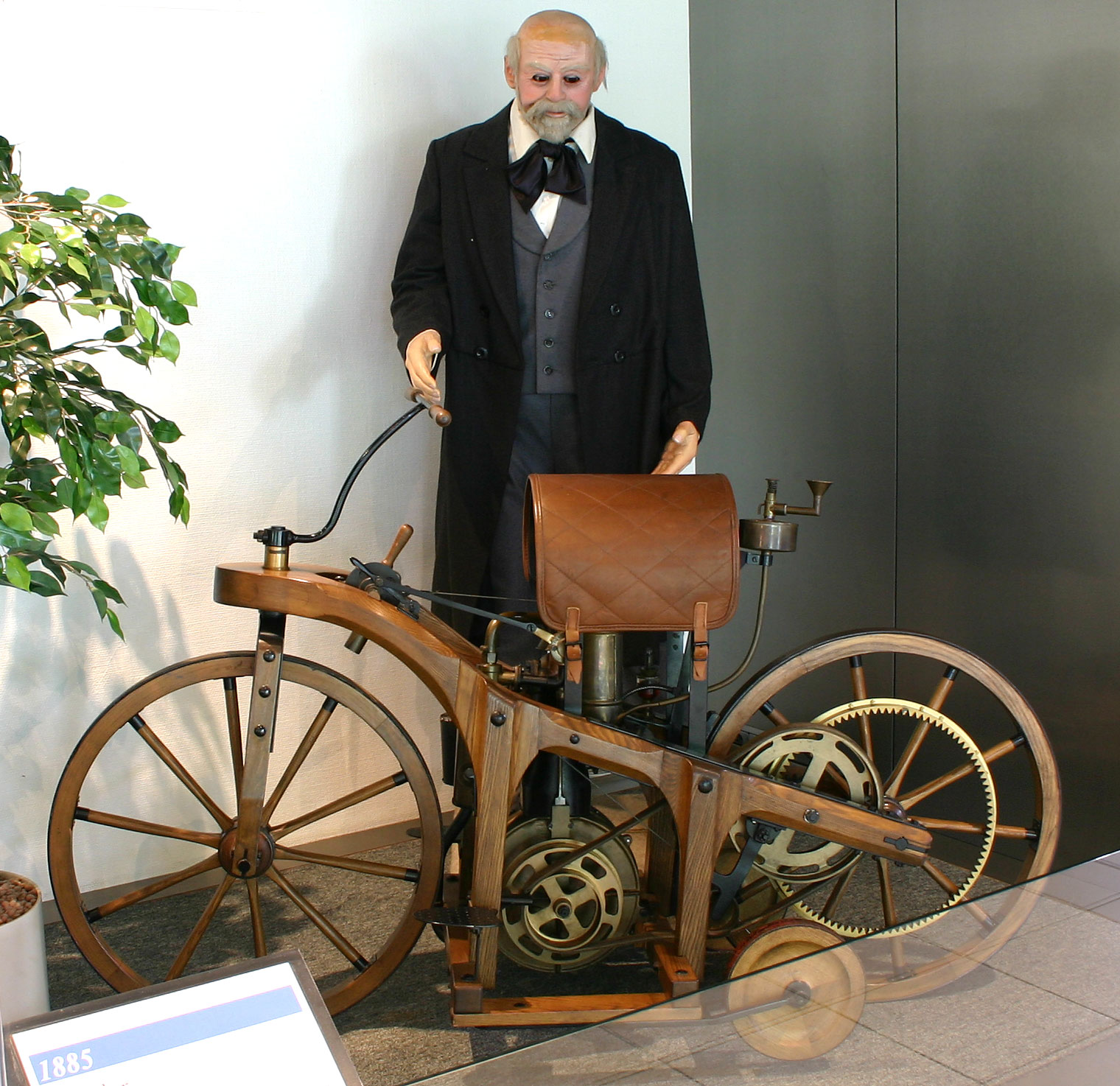
The original Son of Anarchy, about to my mount my Daimler crotch rocket.
Thinking that I would also enjoy sharing the adventure with a friend, I asked adventurer extraordinaire, George P. Burdell, to accompany me on the ride. He looked at me, and asked, "Why don't we just spend the day at the hospital?"
For the sheer thrill of facing risk head on, few activities beat going to the hospital, even a 420 mile ride on a motor bike.
Whenever I conduct a business case analysis with a client, the model's assumptions are always treated as uncertainties until indicated otherwise. A typical analysis can incorporate anywhere from 10 to 50 such assumptions. The analysis rank orders the most important assumptions by how sensitive the decision metric (e.g, net present value, positive cash flow, sustainable levels of resources, etc.) is to the assumptions and by how likely each assumption might cause regret for taking one course of action over the next best course of action. This latter considerations reveals which uncertainties are critical to achieving satisfaction.
Without doing this kind of analysis, decision makers face thinking through a bewilderingly immense number of implications among the assumptions, which often hampers their ability to commit to action. Sometimes, in an effort to shortcut analysis, decision makers focus on favorite or easy to identify risk factors instead. But this is akin to looking for your keys under a street lamp even though you dropped them in the dark bushes ("But the light is better under the lamp!"). This behavior exposes organizations to undesirable outcomes that could have been anticipated, wasting time and resources fixing potentially avoidable problems.
For discussion: 1. On average, what percentage of the 10-50 assumptions do you think are actually critical to success? 2. How does your company identify critical risk factors and measure their potential impact on important decisions? 3. How does your company ensure that proper attention is placed on important risk factors and not just favorite ones or those easy to identify?
37Signals has a lot of good ideas about software design that I like. In fact, I absolutely love Writeboard and use it often. Unfortunately, their generic statement about planning really only works when the cost of development and other opportunity costs are near zero. Otherwise, when one faces committing expensive capital to the task of generating a return, especially with other people's money, good planning is not only prudent but a moral obligation.
When most people plan, what they are generally doing is laying down a series of tasks with desired durations and costs, essentially a deterministic script, leading to a poorly defined goal. Then they express surprise and frustration when life doesn't follow their script. Then, possibly after several failures, people replace one type of pathology (over analyzing with deterministic assumptions) for another (shooting from the hip).
The big problem is not with planning but with a failure to plan properly. When people come up with one idea about "how to get there", they fail to consider that there is often more than one pathway to their goals (if they even have a clear understanding of what their goals should be), maybe a more valuable one. Furthermore, they don't assess the impact of uncertainties on reaching their goals, both within and between alternate pathways to the same goal. As a result of both failures, they don't develop a proper understanding of comparative capital efficiency of choosing one pathway over another, nor do they develop proper contingency plans when things don't go as anticipated. Good planning is mostly about clearly framing an opportunity, comparing alternative approaches, developing a reasonable plan forward, and developing contingency plans for when deviations occur. But I cannot overemphasize proper framing and comparing alternatives.
I understand 37signals point. Analysis paralysis leads to slow death by value attrition. Unfortunately, when people tire of analysis paralysis, they frequently resort to a "just get it done, already" approach that can actually lead to bigger problems, namely, costly rework or disaster control. I've seen that outcome in about half of the decision failures I've encountered over the last 15 years of decision support and risk consulting. Right now, we're all too familiar with an ongoing disaster in the Gulf of Mexico. A broader body of published evidence shows that "just getting it done" is probably more destructive to shareholder value than analysis paralysis. The solution, though, is not to replace one pathology with another.
Planning is guessing. Yes, but the real question is: what kind of guessing is best? The right approach is one that avoids both pitfalls of analysis paralysis or flying by the seat of one's pants.
If you happen to be in town: Date: Tuesday, March 30th (rescheduled from February 15th) Time: 8:30 a.m. to 10:00 a.m. Cost: FREE for all attendees Location: Georgia Tech Enterprise Innovation Institute 3rd Floor, Wayne Hodges Room - Centergy Building 75 Fifth St - Atlanta, GA 30308 Registration details are here.
During the past century...a mutant form of math has deflected science’s heart from the modes of calculation that had long served so faithfully. To find out more about this mutant, read more here.
We’ve been going back and forth for a century [Keynes] I want to steer markets, [Hayek] I want them set free There’s a boom and bust cycle and good reason to fear it [Hayek] Blame low interest rates. [Keynes] No… it’s the animal spirits [Keynes Sings:] John Maynard Keynes, wrote the book on modern macro The man you need when the economy’s off track, [whoa] Depression, recession now your question’s in session Have a seat and I’ll school you in one simple lesson BOOM, 1929 the big crash We didn’t bounce back—economy’s in the trash Persistent unemployment, the result of sticky wages Waiting for recovery? Seriously? That’s outrageous! I had a real plan any fool can understand The advice, real simple—boost aggregate demand! C, I, G, all together gets to Y Make sure the total’s growing, watch the economy fly We’ve been going back and forth for a century [Keynes] I want to steer markets, [Hayek] I want them set free There’s a boom and bust cycle and good reason to fear it [Hayek] Blame low interest rates. [Keynes] No… it’s the animal spirits You see it’s all about spending, hear the register cha-ching Circular flow, the dough is everything So if that flow is getting low, doesn’t matter the reason We need more government spending, now it’s stimulus season So forget about saving, get it straight out of your head Like I said, in the long run—we’re all dead Savings is destruction, that’s the paradox of thrift Don’t keep money in your pocket, or that growth will never lift… because… Business is driven by the animal spirits The bull and the bear, and there’s reason to fear its Effects on capital investment, income and growth That’s why the state should fill the gap with stimulus both… The monetary and the fiscal, they’re equally correct Public works, digging ditches, war has the same effect Even a broken window helps the glass man have some wealth The multiplier driving higher the economy’s health And if the Central Bank’s interest rate policy tanks A liquidity trap, that new money’s stuck in the banks! Deficits could be the cure, you been looking for Let the spending soar, now that you know the score My General Theory’s made quite an impression [a revolution] I transformed the econ profession You know me, modesty, still I’m taking a bow Say it loud, say it proud, we’re all Keynesians now We’ve been goin’ back n forth for a century [Keynes] I want to steer markets, [Hayek] I want them set free There’s a boom and bust cycle and good reason to fear it [Keynes] I made my case, Freddie H Listen up , Can you hear it? Hayek sings: I’ll begin in broad strokes, just like my friend Keynes His theory conceals the mechanics of change, That simple equation, too much aggregation Ignores human action and motivation And yet it continues as a justification For bailouts and payoffs by pols with machinations You provide them with cover to sell us a free lunch Then all that we’re left with is debt, and a bunch If you’re living high on that cheap credit hog Don’t look for cure from the hair of the dog Real savings come first if you want to invest The market coordinates time with interest Your focus on spending is pushing on thread In the long run, my friend, it’s your theory that’s dead So sorry there, buddy, if that sounds like invective Prepare to get schooled in my Austrian perspective We’ve been going back and forth for a century [Keynes] I want to steer markets, [Hayek] I want them set free There’s a boom and bust cycle and good reason to fear it [Hayek] Blame low interest rates. [Keynes] No… it’s the animal spirits The place you should study isn’t the bust It’s the boom that should make you feel leery, that’s the thrust Of my theory, the capital structure is key. Malinvestments wreck the economy The boom gets started with an expansion of credit The Fed sets rates low, are you starting to get it? That new money is confused for real loanable funds But it’s just inflation that’s driving the ones Who invest in new projects like housing construction The boom plants the seeds for its future destruction The savings aren’t real, consumption’s up too And the grasping for resources reveals there’s too few So the boom turns to bust as the interest rates rise With the costs of production, price signals were lies The boom was a binge that’s a matter of fact Now its devalued capital that makes up the slack. Whether it’s the late twenties or two thousand and five Booming bad investments, seems like they’d thrive You must save to invest, don’t use the printing press Or a bust will surely follow, an economy depressed Your so-called “stimulus” will make things even worse It’s just more of the same, more incentives perversed And that credit crunch ain’t a liquidity trap Just a broke banking system, I’m done, that’s a wrap. We’ve been goin’ back n forth for a century [Keynes] I want to steer markets, [Hayek] I want them set free There’s a boom and bust cycle and good reason to fear it [Hayek] Blame low interest rates. [Keynes] No it’s the animal spirits
“The ideas of economists and political philosophers, both when they are right and when they are wrong, are more powerful than is commonly understood. Indeed the world is ruled by little else. Practical men, who believe themselves to be quite exempt from any intellectual influence, are usually the slaves of some defunct economist.” John Maynard Keynes The General Theory of Employment, Interest and Money
“The curious task of economics is to demonstrate to men how little they really know about what they imagine they can design.” F A Hayek The Fatal Conceit
I am a senior decision support advisor who provides guidance, deep insights, and valuable solutions for senior decision-makers facing complex, high-risk problems related to strategic planning, risk management, project valuation & planning, and project portfolio analysis & management.
My goal is to help people ensure that the decisions they make are well framed (focused on the right problem and clearly defined) and that they understand the implications of uncertainty and risk on the likelihood of achieving their goals.
Business Case Analysis with R: Simulation Tutorials to Support Complex Business Decisions
Check out our tutorial on using the statistical programming language R to conduct business case analysis and simulation and a little bit more.
"A decision was wise, even though it lead to disastrous consequences, if the evidence at hand indicated that it was the best one to make; and a decision was foolish, even though it lead to the happiest possible consequences, if it was unreasonable to expect those consequences." ~Herodotus, ca. 500 BC.






 by Katherine Rosback
 by Cameron Davidson-Pilon
 by Robert D. Brown III
 by Michael S. Allen
 by Chet Richards
 by Michael E. Porter
 by Devinderjit Sivia
 by David Charlesworth
 by John Celona and Peter McNamee
 by by Carl Spetzler, Hannah Winter, and Jennifer Meyer
 by Dr. J. Edward Russo and Dr. Paul J. H. Schoemaker
 by John Kruschke
 by Douglas W. Hubbard
 by Sam L. Savage and Jeff Danziger
 by Ronald A. Howard and Ali E. Abbas
 by William Spaniel
 by Paul Papayoanou
 by Gregory S. Parnell PhD, Terry Bresnick MBA, Steven N. Tani PhD, Eric R. Johnson PhD
 by Douglas W. Hubbard
 by Douglas W. Hubbard and Richard Seiersen
 by Robert W. Winkler
 by Robert T. Clemen
 by Carol Tavris and Elliot Aronson
 by Andrew Roman Wells and Kathy Williams Chiang
 by Michael Lewis
 by Richard J. Heuer
 by Gerd Gigerenzer
 by Nate Silver
 by Gerd Gigerenzer, Peter M. Todd, ABC Research Group
 by John S. Hammond, Ralph L. Keeney, Howard Raiffa
 by David Matheson, Jim Matheson
 by Daniel Kahneman
 by Donella H. Meadows
 by Avinash K. Dixit, Barry J. Nalebuff
 by M. Granger Morgan, Max Henrion, Mitchell Small
 by Ralph L. Keeney
 by Patrick Leach
 by Paul C. Nutt
 by David McRaney
 by David McRaney